
You do not need to choose between logging 10,000 steps and taking a daily 30-minute brisk walk to protect your heart. Both habits offer proven cardiovascular protection by strengthening your circulation and lowering arterial pressure.
Fitness trackers often frame daily step counts and structured aerobic walks as competing philosophies. However, cardiovascular research confirms that overall movement volume and sustained brisk pacing work toward the same life-saving outcome.
Understanding how walking speed and daily step totals interact empowers you to build an effective routine. You can optimize your heart health without obsessing over arbitrary digital targets.
The Origins of Step Benchmarks Versus Aerobic Guidelines
Many people treat 10,000 steps as an official medical standard, yet it began as a marketing tactic. A Japanese company introduced the benchmark in 1965 to promote a pedometer named Manpo-kei, meaning “10,000-steps meter.”
In contrast, clinical guidelines emphasize accumulated aerobic duration and intensity. The American Heart Association recommends at least 150 minutes of moderate-intensity aerobic activity or 75 minutes of vigorous activity weekly.
Federal recommendations from the Centers for Disease Control and Prevention mirror this 150-minute threshold, commonly met through 30-minute brisk walks five days weekly. Official CDC guidelines do not mandate a 10,000-step target.
Public health agencies also urge adults to complete muscle-strengthening exercises at least two days weekly. This combination supports metabolic resilience and preserves mobility as you age.
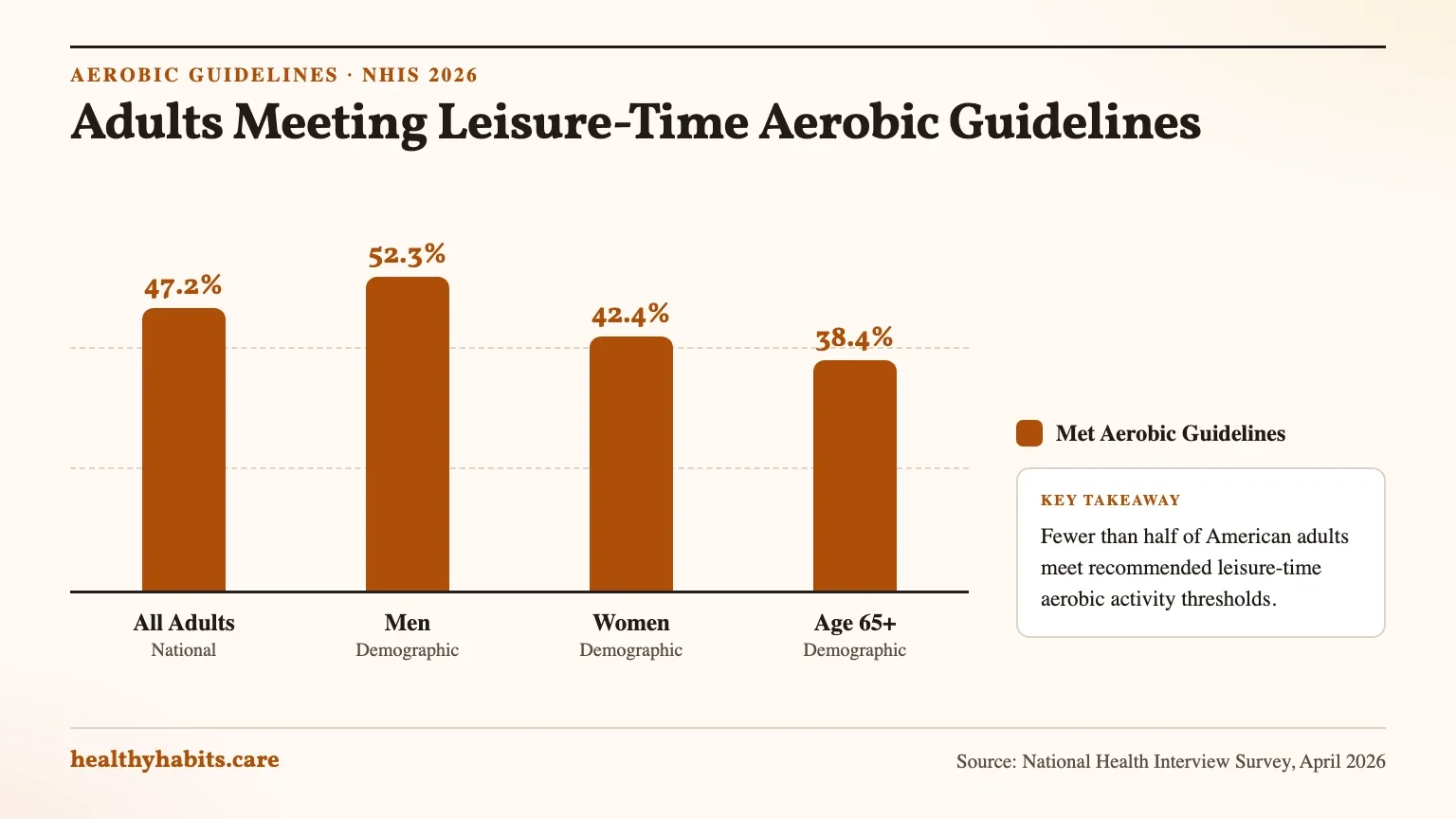
National Health Interview Survey data published on April 7, 2026, revealed that 47.2% of American adults met leisure-time aerobic guidelines. Only 26.4% met both aerobic and muscle-strengthening benchmarks.
Among specific demographics, 52.3% of men, 42.4% of women, and 38.4% of adults aged 65 and older met aerobic targets. Globally, the World Health Organization reported in June 2024 that 31.3% of adults were insufficiently active.
What Recent Cardiovascular Research Shows About Step Counts
Cardiovascular protection accumulates well before you reach 10,000 daily steps. Large-scale clinical investigations confirm that meaningful risk reductions occur at far lower thresholds.
A meta-analysis of 57 studies published in The Lancet Public Health on July 23, 2025, evaluated daily walking patterns. Walking 7,000 steps daily was linked to a 25% lower risk of cardiovascular disease incidence compared to 2,000 steps.
That review also linked 7,000 daily steps to a 47% lower risk of cardiovascular mortality and all-cause mortality. Cardiovascular mortality risk reached an optimal plateau around 5,500 daily steps.
Cardiovascular disease incidence showed an inflection point at 7,802 steps per day for general adults and 5,400 steps for older adults. Modest additional improvements continued up to 10,000 steps.
These results corroborate a 111,309-adult meta-analysis published in the Journal of the American College of Cardiology on September 6, 2023. Significant cardiovascular event reductions began at 2,735 daily steps, plateauing at 7,126 steps.
Furthermore, a 2024 cohort study in JAMA Internal Medicine followed 14,399 older women across nine years. Researchers found that moderate-to-vigorous physical activity minutes and daily step counts had qualitatively similar associations with lower mortality and heart disease.

The Power of Brisk Cadence and Continuous Walking Bouts
Step totals tell only part of the story; walking cadence directly determines cardiovascular exertion. Exercise physiologists identify 100 steps per minute as the baseline threshold for moderate-intensity walking.
At this tempo, a 30-minute brisk walk equals roughly 3,000 to 3,600 steps. That focused bout satisfies the moderate aerobic activity recommended by preventive cardiologists.
A study in the British Journal of Sports Medicine published on September 8, 2026, tracked 64,743 adults across eight years. Researchers examined daily step totals alongside peak 30-minute walking cadence.
Adults taking under 5,000 steps daily at a peak cadence of 80 steps per minute achieved a 28% lower mortality risk. That matched the 30% reduction seen in adults taking 5,000 to 7,500 slower steps at 60 steps per minute.
The lowest mortality risk occurred among adults taking 7,500 to 10,000 steps daily while sustaining roughly 100 steps per minute. That combination produced a 43% lower mortality risk.
How you accumulate steps also influences your cardiovascular resilience. A study in the Annals of Internal Medicine published on October 28, 2025, evaluated 33,560 adults averaging 8,000 or fewer daily steps.
Accumulating steps in continuous walks lasting 10 to 15 minutes or longer delivered superior protection compared to brief bursts under five minutes. Sustained sessions altered metabolic and vascular outcomes dramatically.
Over 9.5 years, cumulative cardiovascular disease incidence dropped from 13.03% in short-burst walkers to 4.39% among those walking 15 minutes or longer. That shift represented an estimated 68% to 70% lower cardiovascular risk.
Sustained walking sessions yielded an 80% to 83% lower mortality risk compared to scattered steps. The greatest absolute benefits emerged among previously sedentary individuals.
Brisk walking provides crucial support if you manage hypertension. An August 2025 study in the European Journal of Preventive Cardiology evaluated 32,192 adults with high blood pressure.
Every 1,000 extra steps above a 2,300-step baseline was linked to a 17% lower risk of major adverse cardiovascular events. This included a 22% lower heart failure risk and a 24% lower stroke risk.
Averaging 80 steps per minute during the fastest 30 minutes of the day reduced major cardiovascular event risk by 30%. A brisk cadence preserves arterial elasticity and supports vascular health.
Practical Action Steps to Structure Your Walking Routine
You do not need to transform your schedule overnight to strengthen your cardiovascular system. Focus on establishing consistent, continuous brisk walking sessions throughout your week.
Aim for a walking pace of at least 2.5 miles per hour, or roughly 100 steps per minute. At this tempo, you can speak in short sentences but cannot comfortably sing.
Schedule two 15-minute brisk walks each day if a continuous 30-minute window proves difficult. Walking after meals also aids in stabilizing blood sugar levels and managing resting blood pressure.
Add incidental movement on top of your structured walks to naturally raise your daily step count. Choose stairs instead of elevators, park farther from entrances, and stand during phone conversations.
Incorporate muscle-strengthening exercises on at least two non-consecutive days each week. Bodyweight squats, wall push-ups, and light resistance bands satisfy national guidelines and stabilize your joints.
Listen carefully to your body whenever you increase your walking pace or duration. If you experience chest tightness, sudden shortness of breath, irregular heartbeats, or severe dizziness, stop immediately and seek emergency medical care.
Consult your physician before significantly changing your activity levels, especially if you manage heart disease or joint complications. Your doctor can recommend safe target heart rate zones for your condition.

Accessible Tools and Community Walking Resources
You do not need expensive gym memberships or high-end smartwatches to build an effective walking habit. Free smartphone applications and basic mechanical pedometers track your daily progress accurately.
Public parks, school tracks, and indoor shopping centers provide flat, measured walking paths that make steady pacing manageable. Many municipal parks feature designated trail loops that clearly display distance markers.
Joining a local walking club offers regular social accountability and helps reduce isolation. Community health centers, senior facilities, and public libraries frequently organize free neighborhood walking groups.
National organizations like the National Institutes of Health supply accessible heart health toolkits and printable physical activity logs. Programs such as SilverSneakers provide structured fitness options tailored for older adults.
Frequently Asked Questions About Walking and Heart Health
Can I split my 30-minute brisk walk into shorter intervals?
Yes, dividing your daily brisk walk into two 15-minute sessions provides comparable cardiovascular benefits. Research confirms that continuous bouts of at least 10 to 15 minutes effectively promote vascular health.
Does casual household strolling count the same as brisk walking?
Casual strolling contributes to your overall daily step volume, which reduces sedentary risks. However, brisk walking elevates your heart rate to moderate intensity, delivering greater conditioning to your heart and arteries.
What if joint pain prevents me from reaching 7,000 daily steps?
You do not need 7,000 steps to protect your cardiovascular system. Significant cardiovascular risk reductions begin at roughly 2,700 steps daily, especially when you maintain a brisk pace during intentional walking sessions.
You can also try low-impact activities like water walking or recumbent cycling to ease stress on your joints. Always work with your physical therapist or physician to adjust movements safely.
How do I know if my walking pace qualifies as moderate intensity?
Use the simple talk test during your walk to gauge moderate intensity. If you can speak comfortably but lack the breath to sing, you have reached moderate intensity.
Alternatively, count your steps for one minute using a watch or phone timer. Reaching approximately 100 steps in 60 seconds indicates you are walking at a brisk, heart-healthy pace.
Building Sustainable Momentum for Lifelong Longevity
You do not have to choose between accumulating daily steps and enjoying focused brisk walks. Both metrics guide you toward lower blood pressure, improved circulation, and enhanced longevity.
Rather than chasing an arbitrary 10,000-step benchmark, focus on reaching at least 7,000 steps or completing a continuous 30-minute brisk walk. Consistency over time produces the greatest cardiovascular rewards.
Choose one simple action today, such as taking a brisk 15-minute walk around your neighborhood. Every purposeful step you take strengthens your heart and protects your future health.