
Collagen powders, gummies, and capsules promise youthful skin and pain-free joints, but separating clinical reality from marketing hype requires looking at the actual data. You deserve clear, practical guidance before spending your hard-earned money on daily supplements.
Emerging clinical research confirms that specific collagen peptides can improve skin hydration and ease joint discomfort; however, they are not universal cures for aging. Knowing what the science truly supports protects your health and your household budget.
Here is what leading dermatologists, rheumatologists, and clinical trial data want you to evaluate before adding a collagen supplement to your wellness routine.
Understanding Collagen and Natural Depletion
Collagen serves as the primary structural protein in your body, comprising roughly a third of your total protein mass. It provides essential tensile strength to your skin, bones, tendons, ligaments, and cartilage.
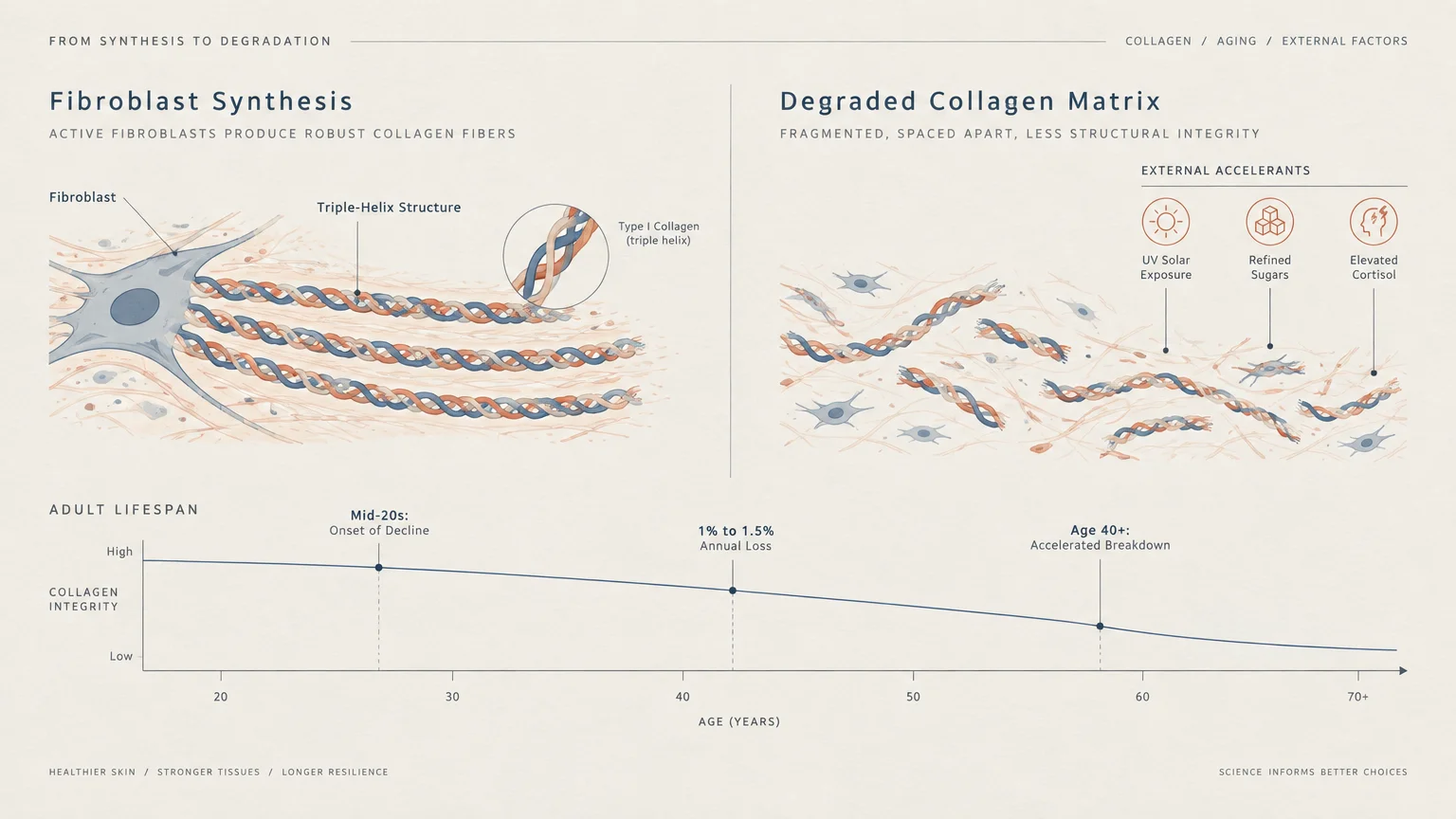
Specialized connective tissue cells known as fibroblasts actively synthesize these structural protein cables. They weave specific amino acids into sturdy triple-helix configurations that keep your physical tissues resilient.
Your body’s natural collagen production begins declining in your mid-20s at a rate of approximately 1% to 1.5% per year. As fibroblast activity slows down, your connective tissues gradually lose their natural resilience.
This subtle annual decline compounds over time, contributing to thinner skin, subtle joint friction, and slower tissue repair. Many adults first notice these structural changes when minor morning stiffness or fine expression lines emerge.
The rate of collagen depletion accelerates significantly after age 40 and drops even faster during menopause. Rapid hormonal shifts impair fibroblast function, leading to a substantial drop in skin thickness and bone density.
Internal biological aging is only one part of the equation, as external lifestyle choices strongly dictate collagen breakdown. Unprotected exposure to solar ultraviolet rays activates destructive enzymes that chop healthy collagen fibers into useless fragments.
Inhaling tobacco smoke restricts microvascular blood flow to your skin, starving fibroblasts of essential oxygen and nutrients. Diets packed with refined sugars create advanced glycation end-products that make flexible collagen fibers rigid and brittle.
Chronic emotional stress also elevates systemic cortisol levels, an inflammatory hormone that actively degrades delicate connective tissues. Understanding these underlying biological mechanisms explains why so many individuals explore oral collagen supplements to replenish depleted stores.
Clinical Evidence: What the 2026 Data Actually Shows
The scientific community recently reached a critical milestone in evaluating whether oral collagen genuinely delivers measurable benefits. For years, skepticism dominated the clinical discourse because early studies lacked adequate sample sizes and rigorous controls.
A landmark June 2026 umbrella review led by researchers at Anglia Ruskin University analyzed 16 systematic reviews covering 113 randomized controlled trials and 7,983 participants. This extensive paper represents the most thorough synthesis of collagen research conducted to date.
Published in the Aesthetic Surgery Journal Open Forum, this comprehensive review confirmed that consistent collagen supplementation provides meaningful improvements for skin elasticity and skin hydration. The aggregated data showed genuine physical changes rather than mere placebo effects.
The researchers also determined that oral collagen significantly reduces osteoarthritis pain and joint stiffness in adults. These clinical findings offer legitimate reassurance if you seek targeted relief for aging skin or creaky knees.
However, the umbrella review revealed clear boundaries regarding what collagen supplements cannot accomplish. Researchers found little to no benefit for boosting athletic performance, accelerating post-workout recovery, or reducing muscle soreness.
The data also showed no meaningful impact on cardiometabolic factors, including resting blood pressure and systemic cholesterol levels. Collagen is not a whole-body tonic, so you should avoid products that claim to enhance cardiovascular fitness.
A 2025 meta-analysis published in the American Journal of Medicine echoed positive dermatological outcomes across 23 randomized controlled trials and 1,474 participants. That analysis demonstrated notable improvements in skin hydration and measurable reductions in facial wrinkle depth.
These combined findings prove that collagen is not inert snake oil, but its clinical value remains restricted to specific structural tissues. Knowing these boundaries prevents unrealistic expectations and keeps your wellness goals grounded in verified facts.

Examining Industry Bias and Clinical Trial Limitations
While large reviews report positive outcomes, discerning consumers must recognize the limitations within supplement research. Independent researchers frequently urge caution when evaluating commercial health studies, and collagen is no exception.
An August 2026 systematic review in MDPI examining 15 randomized controlled trials highlighted frequent methodological weaknesses in existing studies. Many included clinical trials featured short follow-up periods and small sample sizes that make long-term assumptions difficult.
An October 2026 critical appraisal in the Journal of Cosmetic Dermatology issued a similar warning regarding pervasive industry involvement. Commercial supplement manufacturers directly funded or coordinated many published trials, creating potential conflicts of interest.
Industry-sponsored trials are statistically more likely to report favorable results than independently funded research. Companies naturally design protocols to highlight positive outcomes while minimizing ambiguous or neutral findings.
These commercial ties do not automatically invalidate the positive findings, but they demand healthy skepticism from consumers. You should always distinguish between genuine biological improvements and aggressive marketing campaigns designed to drive sales.
Researchers emphasize the urgent need for larger, multi-year, independent trials that follow diverse populations over extended periods. Independent validation will help establish definitive clinical protocols and confirm whether benefits persist safely over decades.
Maintaining an objective perspective allows you to make informed decisions without falling victim to exaggerated marketing promises. Supplements can play a supporting role in your health, but they should never replace fundamental self-care practices.
Market Growth and FDA Regulatory Realities
The commercial interest in collagen products has expanded into a multi-billion-dollar global enterprise. Walk down any supermarket aisle or browse social media, and you will encounter an overwhelming assortment of peptide powders.
Market analysts valued the global collagen supplements market at $5.84 billion in 2025, with projections reaching $6.44 billion in 2026. Forecasters estimate this expanding consumer market could climb to $7.5 billion by 2027.
Between 2021 and 2025, supplement product launches featuring collagen ingredients grew by 6% annually across grocery and pharmacy shelves. This rapid commercial explosion outpaces the growth of many traditional vitamin categories.
Despite this massive commercial presence, regulatory protections remain surprisingly minimal for everyday consumers. Many shoppers assume that products sold on major retail shelves have passed rigorous pre-market safety reviews.
The Food and Drug Administration does not review or approve dietary supplements for safety or efficacy before manufacturers sell them. The agency’s regulatory structure treats dietary supplements differently than prescription medications or over-the-counter drugs.
Federal regulators only step in after a product reaches the market if consumers report adverse events or dangerous contamination. This post-market enforcement model leaves the burden of quality control primarily on supplement manufacturers.
Hydrolyzed collagen does maintain “Generally Recognized as Safe” status for use as a food ingredient. That basic safety designation, however, does not guarantee that a specific bottle contains the precise dosage stated on the label.
Independent quality verification provides the strongest safeguard against mislabeled, adulterated, or contaminated supplements. You can protect yourself by actively checking packaging for independent certification seals before making a purchase.
Experts strongly advise selecting products bearing seals from reputable third-party testing programs such as USP, NSF, or NutraStrong. These independent laboratories test supplement batches to verify purity, potency, and the total absence of toxic heavy metals.
Effective Dosages, Peptide Types, and Biological Timelines
Navigating store shelves requires understanding the biological differences between collagen formulations. You cannot simply grab the first container you see and expect optimal physiological absorption.
Native collagen molecules are large triple-helix proteins that your digestive enzymes struggle to absorb intact. When you swallow unprocessed collagen, your stomach acids break it down into random amino acids like any ordinary dietary protein.
High-quality supplements use hydrolyzed collagen peptides, which manufacturers break down through enzymatic hydrolysis into short amino acid chains. These smaller peptide fragments pass smoothly through your intestinal barrier directly into your bloodstream.
Once absorbed, these specific peptide sequences act as biological signaling messengers that trigger your fibroblast cells to synthesize brand-new collagen structures. They provide both the instructional signal and the raw materials needed for structural repair.
In recent clinical trials from 2025 and 2026, effective daily oral dosages for skin health ranged from 1.65 grams to 2.5 grams. Taking these modest daily amounts produced measurable improvements in tissue hydration and skin elasticity.
Broader clinical investigations evaluating joint health often utilize higher daily doses up to 10 grams. Individuals managing joint stiffness or cartilage wear frequently require these larger daily amounts to experience noticeable pain relief.
You must exercise patience when beginning a supplement regimen, as biological tissue remodeling takes time. Collagen synthesis is a gradual cellular process that cannot be rushed through excessive daily intake.
Meaningful improvements in skin hydration and joint comfort typically require consistent daily intake for at least 8 to 12 weeks. Clinical studies consistently show that visible benefits only emerge after two to three months of uninterrupted supplementation.
Expecting visible changes in a few days or weeks will only lead to disappointment and wasted effort. Consistency matters far more than taking megadoses, as your body excretes surplus amino acids it cannot process.
Collagen synthesis also relies on essential dietary co-factors to assemble new structural proteins properly. Without these critical helper micronutrients, your fibroblasts cannot link amino acids into sturdy tissue matrices.
Your cells specifically require adequate vitamin C and zinc to bind amino acids into resilient triple-helix collagen fibers. A severe deficiency in vitamin C completely halts your body’s ability to manufacture structural connective tissue.
Pairing your daily supplement with a vitamin C-rich snack or choosing a formula with added micronutrients optimizes results. This simple nutritional adjustment ensures your cellular machinery has everything required to build healthy skin and cartilage.

Whole-Food Nutrition and Lifestyle Protection Strategies
Taking a daily supplement cannot compensate for an unhealthy diet that lacks adequate foundational nutrients. You should always treat supplements as an addition to, rather than a replacement for, healthy lifestyle habits.
You can support your body’s structural matrix naturally by consuming nutrient-dense whole foods rich in bioavailable protein. When you ingest dietary proteins, your digestive system breaks them down into amino acids that fuel cellular repair.
Dietary sources like bone broth, wild-caught fish, poultry, and eggs naturally deliver the raw amino acids your body needs. Eating these whole foods provides a broad spectrum of minerals and peptides that nourish your joints.
Plant-based foods such as beans, lentils, pumpkin seeds, and tofu also provide generous amounts of proline and glycine. Vegetarian and vegan diets can easily supply the chemical precursors needed to fuel internal collagen production.
The National Institutes of Health provides comprehensive guidance on meeting your daily micronutrient requirements through balanced nutrition. Consulting these evidence-based nutritional guidelines helps you build balanced meals that support healthy tissue maintenance.
Citrus fruits, bell peppers, strawberries, and dark leafy greens supply the high concentrations of vitamin C vital for collagen formation. Adding these vibrant foods to your daily meals ensures your cells have steady access to essential antioxidants.
Protecting your existing collagen is just as essential as encouraging new production. Preserving the structural matrix you already possess prevents premature tissue breakdown and maintains joint mobility.
Daily application of broad-spectrum sunscreen prevents ultraviolet radiation from activating destructive collagen-degrading enzymes. Sun protection remains the single most effective intervention for preventing premature skin aging and loss of elasticity.
Avoiding tobacco products prevents toxic chemicals from constricting capillaries that feed nutrients to your skin and joints. Quitting smoking immediately improves peripheral blood flow and allows your tissues to heal more efficiently.
Prioritizing restorative sleep allows human growth hormone to trigger cellular repair and connective tissue maintenance overnight. Chronic sleep deprivation elevates systemic inflammation, accelerating the breakdown of healthy joint cartilage and skin cells.
Managing chronic emotional stress reduces cortisol, a hormone known to degrade connective tissues when persistently elevated. Daily relaxation practices like walking, meditation, and deep breathing shield your structural proteins from chronic hormonal stress.
Partnering With Your Healthcare Provider
Consulting a qualified healthcare professional is an essential first step before introducing new supplements into your routine. Your primary care physician can evaluate your complete health history and ensure supplements do not mask underlying conditions.
If you experience persistent joint pain, an accurate diagnosis is crucial for protecting long-term mobility. Self-treating joint stiffness with over-the-counter powders can delay essential medical treatments for progressive musculoskeletal conditions.
While collagen may soothe mild discomfort from osteoarthritis, it cannot treat systemic inflammatory conditions like rheumatoid arthritis. Autoimmune joint diseases require prescription disease-modifying therapies to halt progressive joint destruction.
The Arthritis Foundation emphasizes that inflammatory autoimmune diseases require targeted medical therapies to prevent permanent joint destruction. Delaying clinical care while relying on dietary supplements can result in irreversible joint deformities.
People with preexisting kidney disease should exercise caution, as excessive protein supplementation places added filtration stress on kidneys. Individuals with impaired renal clearance must strictly monitor their total daily protein intake under medical supervision.
Your doctor can also assess potential interactions with prescribed medications or other daily supplements. Certain marine-sourced collagen products, for instance, contain high amounts of calcium that might interfere with thyroid medications.
If you decide to proceed, tracking your symptoms in a written journal provides objective data on whether the supplement works. Documenting daily changes helps you determine whether your financial investment produces genuine functional benefits.
Note daily changes in skin dryness, joint stiffness, and physical comfort over a continuous three-month period. Having concrete written observations makes your follow-up medical appointments much more productive and informative.
If you observe no tangible benefits after 12 weeks of daily use, discuss discontinuing the supplement with your provider. Ceasing an ineffective supplement saves you money and frees resources for clinical interventions that work.

Community Support and Trusted Healthcare Resources
Navigating dietary supplements can feel overwhelming without reliable, evidence-based guidance. You do not have to evaluate confusing marketing claims in isolation or rely on unsubstantiated social media testimonials.
Community health centers, hospital wellness seminars, and registered dietitians offer accessible guidance tailored to your individual needs. These local community resources provide personalized nutritional evaluations without the commercial pressure to buy expensive products.
The Centers for Disease Control and Prevention publishes authoritative materials on healthy aging, joint health, and chronic disease management. Their public health resources provide reliable benchmarks for physical activity, dietary standards, and arthritis self-management strategies.
Patient advocacy groups provide free toolkits, evidence summaries, and support forums for individuals living with joint discomfort. Connecting with these organizations helps you learn practical coping mechanisms from people facing similar mobility challenges.
Educational platforms hosted by academic medical centers regularly publish objective analyses of emerging supplement research. Reading unbiased reviews written by university clinicians helps you separate genuine scientific breakthroughs from commercial exaggerations.
Reaching out to these public health tools ensures you make choices anchored in clinical science rather than social media algorithms. High-quality public education empowers you to take control of your wellness journey safely and effectively.
Discussing supplement options with your local pharmacist is another free, highly accessible way to verify product safety. Pharmacists are medication and formulation experts who understand bioavailability, absorption kinetics, and safety standards.
Pharmacists possess specialized expertise in supplement-drug interactions and can identify third-party certified brands on local shelves. Never hesitate to bring a supplement bottle to the pharmacy counter and ask for professional guidance.
Frequently Asked Questions About Collagen Supplements
Does drinking collagen work better than using topical collagen creams?
Yes, oral collagen peptides deliver structural components far more effectively than topical skin creams. Oral ingestion allows active peptides to circulate systemically through your bloodstream directly to deep tissue layers.
Whole collagen molecules in skin creams are simply too large to penetrate through your protective skin barrier. While topical creams provide excellent surface hydration, oral peptides stimulate fibroblasts from within the deeper dermis.
Dermatologists agree that consuming hydrolyzed peptides yields measurable improvements in skin elasticity that topical collagen formulations cannot match. Topical creams hydrate outer layers, but ingestible peptides support deep dermal architecture.
Are vegan collagen supplements legitimate alternatives to animal-derived products?
True collagen only exists naturally in animal tissues, meaning authentic vegan collagen supplements do not exist. Collagen is an animal protein found exclusively in the connective tissues of mammals, birds, and marine life.
Products marketed as vegan collagen typically consist of plant extracts, amino acids, and vitamins designed to support natural production. These booster blends supply building blocks like vitamin C and glycine to aid internal synthesis.
Emerging biotechnology utilizes genetically modified yeast and bacteria to create vegan peptides, but clinical research remains in early stages. Until human trials validate these lab-grown options, plant boosters remain your primary vegan alternative.
Can collagen supplements cause adverse side effects or digestive issues?
Hydrolyzed collagen supplements are generally well tolerated, but some individuals report mild digestive upset. Clinical trials report low rates of adverse events when participants consume standard therapeutic dosages.
Common complaints include feelings of fullness, minor stomach bloating, or a lingering unpleasant aftertaste. These mild gastrointestinal symptoms typically resolve quickly if you reduce your daily dosage or take peptides with meals.
You must also verify raw sources carefully if you suffer from allergies to fish, shellfish, or eggs. Individuals with severe seafood allergies must avoid marine collagen to prevent dangerous allergic reactions.
How long do you need to take collagen to maintain your results?
The benefits of collagen supplementation persist only as long as you continue taking the product regularly. When you ingest peptides daily, you provide constant chemical signaling to your tissue-building cells.
Once you stop daily supplementation, your fibroblast stimulation ceases and collagen synthesis returns to its baseline rate. Your body naturally continues its age-related collagen decline once you remove the supplemental peptide signals.
Discontinuing supplements will not ruin your skin or joints, but improvements in hydration and stiffness will gradually fade. You must view collagen as an ongoing daily habit rather than a permanent structural cure.
Building Your Practical Action Plan
Making healthy choices for your body does not require radical changes or expensive supplement regimens. You can achieve meaningful improvements by adopting a steady, methodical approach to your health routines.
Begin by evaluating your daily habits, ensuring you eat nutrient-dense meals and protect your skin from sun damage. Whole-food nutrition and sun protection form the non-negotiable foundation of tissue preservation.
If you choose to trial collagen, select a third-party certified hydrolyzed peptide formula backed by clinical dosages. Look for seals from USP, NSF, or NutraStrong to guarantee chemical purity and accurate labeling.
Commit to taking 1.65 to 2.5 grams daily for skin, or up to 10 grams daily for joint stiffness. Maintain this routine consistently for at least 8 to 12 weeks while tracking your physical comfort.
Partnering with your healthcare team empowers you to make thoughtful, science-backed decisions for long-term health and vitality. By combining realistic expectations with verified clinical facts, you can support your body with complete confidence.