Protecting your morning routine can help you preserve your independence, steady energy, and active time with family as you age. Recent research shows your risk of stroke climbs sharply during a narrow three-hour window right after sunrise.
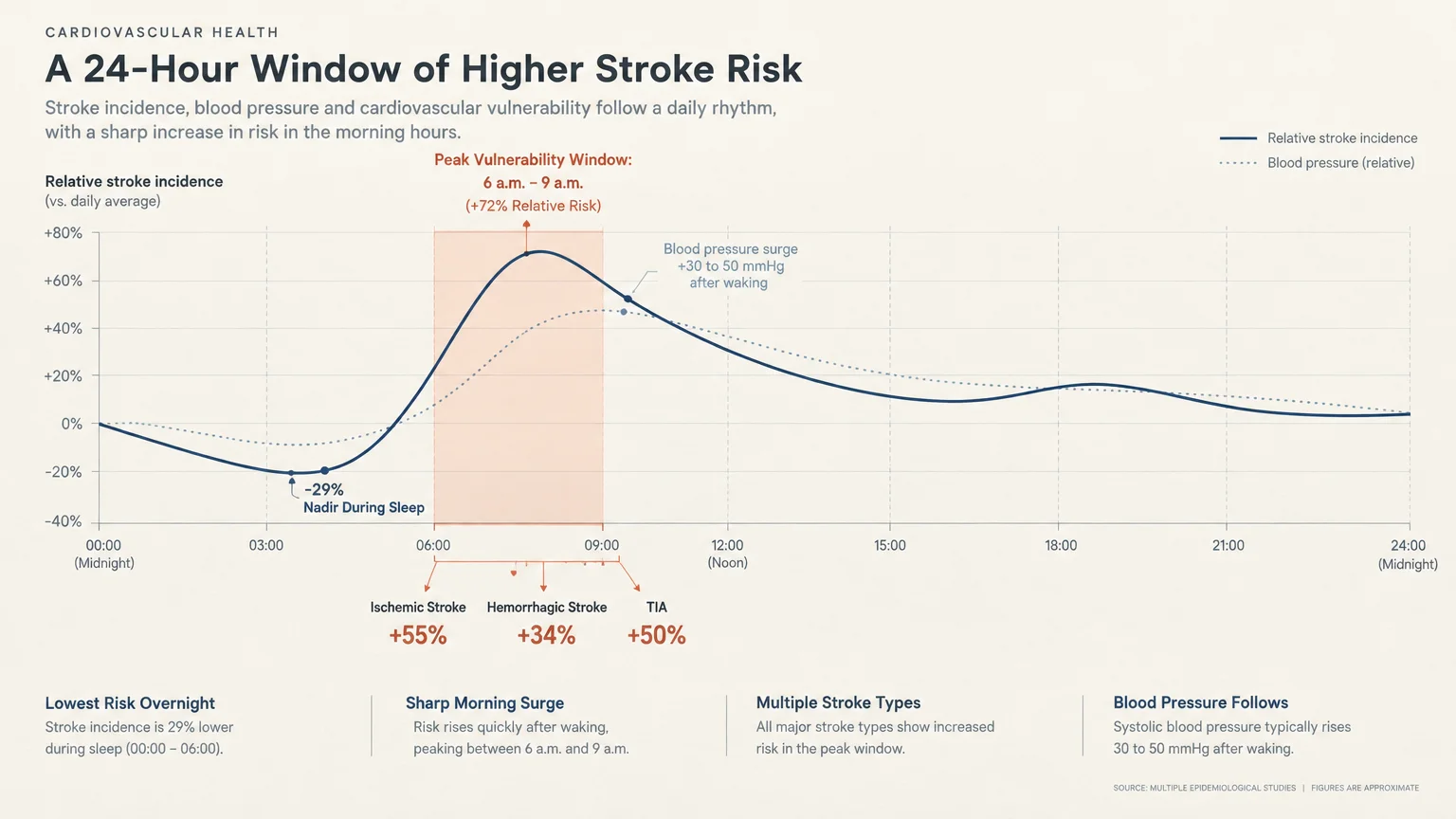
Between 6 a.m. and 9 a.m., people are 72% more likely to experience a stroke than during the rest of the day. Understanding why your body shifts at daybreak puts real preventive power back in your hands.
You will learn what drives this morning surge, how to recognize urgent warning signs, and which daily habits lower your risk safely.
Why Your Stroke Risk Spikes Between 6 a.m. and 9 a.m.
Your internal body clock does more than tell you when to sleep and wake. It coordinates blood pressure, stress hormones, and blood clotting across every 24-hour cycle—creating a clear peak in cardiovascular vulnerability during the early morning.
Coverage by The Washington Post, MedPage Today, and Men’s Journal highlights that people are 72% more likely to have a stroke between 6 a.m. and 9 a.m. than during the rest of the day.
That figure reflects a relative risk increase rather than 72% of all strokes happening before nine. The Rush University meta-analysis of 31 studies covering 11,816 strokes by William J.
Elliott, MD, found a 49% overall rise from 6 a.m. to noon.
Compared with the other 18 hours, that morning window carried a 79% higher overall risk. Ischemic strokes rose 55%, hemorrhagic strokes rose 34%, and transient ischemic attacks rose 50%, while midnight to 6 a.m. saw 29% fewer.
These numbers matter even more after age 50, when vascular wear accumulates. According to the Centers for Disease Control and Prevention and the American Heart Association, someone in the United States has a stroke every 40 seconds.
That adds up to nearly 800,000 strokes each year—more than 600,000 first-time strokes and 200,000 recurrent events. Roughly 80% to 85% of U.S. strokes are ischemic, meaning a clot blocks blood flow to part of the brain.
Stroke also ranks as the No. 4 leading cause of death in the United States, accounting for 162,639 deaths in 2023 and 166,852 deaths in 2024. Between 2013 and 2023, crude stroke death rates climbed 18.2% among adults aged 85 and older.
Surviving a stroke often changes daily life for the entire family. About 7.8 million U.S. adults have had a stroke, roughly half live with permanent physical or cognitive disabilities, and up to one-third develop cognitive impairment or dementia.
Timing matters for recovery, too. About 20% to 25% of acute ischemic strokes happen during sleep and are discovered upon waking, and a June 2026 Neurology review linked late-night or early-morning onset to up to 23% worse recovery at three months.
What Happens Inside Your Body Before and After You Wake
A morning stroke rarely stems from one single trigger. Instead, three normal biological rhythms overlap near dawn, placing extra strain on blood vessels that may already carry plaque or age-related stiffness.
The Morning Blood Pressure Surge
During healthy sleep, your blood pressure dips by 10% to 20%, reaching its lowest point around 3 a.m. Your heart and arteries get a brief overnight rest while your body repairs tissue and conserves energy.
Before you even open your eyes, your sympathetic nervous system flips the switch toward daytime alertness. Adrenaline, cortisol, and the renin-angiotensin-aldosterone system tighten blood vessels and raise your pulse to prepare you for standing and moving.
Stress hormones called catecholamines peak between 6 a.m. and 9 a.m., pushing blood pressure sharply upward. Readings typically peak between 8 a.m. and 10 a.m., often climbing 30 to 50 mmHg higher than your lowest nighttime level.
If your baseline pressure already runs high, that steep climb can stress arterial walls or dislodge plaque. Globally, high systolic blood pressure is the largest contributor to cardiovascular deaths, and 47.3% of U.S. adults—125.9 million people—have hypertension.
Sticky Platelets and Slower Clot Breakdown
At the same hour your blood pressure climbs, your bloodstream becomes more likely to clot and slower to clear tiny blockages. Controlled laboratory studies show your circadian clock drives these shifts even if you stay quietly in bed.
Research from Brigham and Women’s Hospital and Harvard Medical School found that plasminogen activator inhibitor-1, known as PAI-1, peaks around 6:30 a.m. Because PAI-1 blocks your body’s natural clot-dissolving system, small clots linger longer in the early morning.
That internal circadian rise in PAI-1 is eight times larger than changes triggered by standardized physical stressors. Meanwhile, Harvard and Boston chronobiology research demonstrated that platelets—the cell fragments that clump to seal leaks—reach peak stickiness during the biological morning.
Combine narrower, higher-pressure vessels with stickier platelets and slower clot clearance, and the early hours become uniquely demanding. When sleep schedules shift erratically, that delicate timing can fray even further.
Why Aging Makes Morning Swings Matter More
As you move past 50, arteries gradually lose some of their natural elasticity. Stiffer vessel walls absorb sudden pressure surges less smoothly, turning a routine morning rise into a sharper jolt for delicate brain circulation.
Sleep architecture also changes with age, bringing lighter sleep stages, earlier waking, or more frequent nighttime bathroom trips. A June 2026 Neurology review reported that chronic circadian disruption raises stroke risk by roughly 4% for every five years of exposure.
You can read more about age-related vascular shifts through the National Institute on Aging. Recognizing these natural transitions helps you work with your body clock rather than fighting it.

Practical Ways to Lower Your Morning Stroke Risk
Biology sets the stage, yet daily choices carry enormous power. According to the American Stroke Association, up to 80% of first-time strokes are preventable through risk-factor control and lifestyle changes, with 60% preventable through clinical risk-factor and lifestyle strategies alone.
You do not need an extreme routine or expensive gear to protect your mornings. Small, steady adjustments tailored to your mobility, budget, and medical history deliver meaningful protection over time.
Keep Your Sleep and Wake Times Steady
Sleeping enough hours matters, yet consistency matters just as much. A November 2024 UK Biobank study of 72,269 adults aged 40 to 79 found that irregular bedtimes and wake times raised stroke, heart attack, and heart failure risk by 26%.
Even adults sleeping seven to nine hours faced higher risk when schedules swung wildly. Lead researcher Jean-Philippe Chaput at the University of Ottawa recommends keeping bed and wake times within 30 minutes—and under one hour—every day, including weekends.
Start by picking a realistic wake time you can keep seven days a week. Step into bright daylight within 20 minutes of rising, or sit near a sunny window with breakfast, to anchor your internal clock.
If pain, caregiving, or frequent waking disrupts your nights, focus on a calm 30-minute wind-down before bed rather than forcing sleep early. You can explore practical sleep-hygiene guidance from the National Heart, Lung, and Blood Institute.
Ease Slowly Into Your First Hour Awake
Because catecholamines and PAI-1 peak between 6 a.m. and 9 a.m., rushing straight from deep sleep into intense exertion can amplify your morning blood pressure jump. Give your circulation a gentle on-ramp before asking your heart to work harder.
When your alarm sounds, lie still for a moment and take three slow breaths. Swing your legs over the bedside and sit upright for a minute before standing, especially if you ever feel lightheaded.
Keep a glass of water nearby so you rehydrate soon after waking. If you enjoy morning stretching, try seated ankle circles, shoulder rolls, and gentle neck turns to wake up blood flow without straining.
Those with limited mobility or joint stiffness can complete this entire warm-up from a sturdy chair. Active adults who feel fine in the morning can still benefit from a relaxed pace during their first 30 minutes awake.
Monitor Morning Blood Pressure and Medication Timing
The American Heart Association’s Life’s Essential 8 targets an optimal blood pressure below 120/80 mmHg, or the personalized goal set by your clinician. Checking your readings at home shows whether your morning surge stays mild or climbs unusually high.
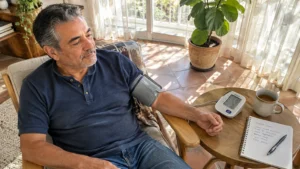
Use an upper-arm cuff that fits properly, sit quietly with your back supported and feet flat for five minutes, and rest your arm at heart level. Log your readings at a consistent morning hour for a week before routine appointments.
Bring that log to your doctor rather than guessing from one office check. Never skip doses or shift blood pressure or blood-thinning medications to bedtime without medical approval, because drug timing interacts with other prescriptions and fall risks.
Build Meals Around Vascular Protection
The 2024 AHA/ASA Guideline for the Primary Prevention of Stroke specifically recommends a Mediterranean dietary pattern—especially supplemented with nuts and olive oil—to lower stroke risk. This approach works whether you are preventing a first event or managing elevated cardiovascular risk.
At breakfast, swap heavily salted processed meats and refined pastries for fiber, healthy fats, and produce. Oatmeal topped with walnuts and berries, or whole-grain toast drizzled with olive oil beside sliced tomato, supports smoother blood vessels without complex prep.
Canned beans, frozen vegetables, plain yogurt, and store-brand extra-virgin olive oil make Mediterranean eating practical on a fixed budget. Cutting excess sodium also eases morning blood pressure spikes across the whole day.
The 2024 guideline gives a Class 2a recommendation for potassium-enriched salt substitutes—75% sodium chloride and 25% potassium chloride—when medically appropriate. Always check with your doctor before using them if you have kidney disease or take blood pressure drugs.
Schedule Movement When Your Body Is Ready
Life’s Essential 8 recommends at least 150 minutes of moderate-intensity activity each week—such as brisk walking—or 75 minutes of vigorous movement. Regular exercise strengthens your heart, lowers resting blood pressure, and helps control blood sugar.
If you manage uncontrolled hypertension or heart disease, intense early-morning workouts right inside the 6 a.m. to 9 a.m. surge may feel taxing. Scheduling brisk walks, swimming, or strength training for mid-morning or afternoon gives your stress hormones time to settle first.
Every fitness level has a safe entry point. You can break 150 weekly minutes into gentle 10-minute walks after meals, seated resistance-band routines, or warm-water pool classes that protect sore knees and hips.
Protect Your Other Core Health Numbers
Morning stroke prevention depends on your whole cardiovascular picture, not blood pressure alone. Life’s Essential 8 sets clear benchmarks: a body mass index from 18.5 to under 25, fasting blood glucose below 100 mg/dL, and non-HDL cholesterol under 130 mg/dL.
Complete avoidance of tobacco and nicotine is equally critical, as people who smoke face three times higher mortality than never-smokers. Even cutting back or starting a quit plan after age 60 brings fast circulation gains.
The payoff reaches far beyond stroke prevention. A meta-analysis of 59 studies cited in the 2026 American Heart Association statistics update linked ideal cardiovascular health to a 74% lower risk of cardiovascular events, younger brain age, slower cognitive decline, and lower dementia risk.
Review Aspirin and Sex-Specific Risks With Your Doctor
Well-meaning habits from decades past do not always fit current evidence. The 2024 AHA/ASA Primary Prevention Guideline recommends against routine daily aspirin to prevent a first stroke in adults aged 70 and older or those with chronic kidney disease, noting no net benefit.
For eligible patients managing metabolic risk or diabetes, the same guideline highlights the cardiovascular and stroke-reduction benefits of GLP-1 receptor agonists. Ask your clinician which medications truly match your current age and lab results.
The 2024 guideline also introduces screening for women’s sex-specific stroke risks. Share any history of preeclampsia, pregnancy complications, endometriosis, hormone therapy or oral contraceptive use, and age at menopause so your care plan fits your story.
Spotting Morning Stroke Warning Signs Fast
Prevention cuts your odds dramatically, yet every household should still know how to act fast when seconds count. On average, 1.9 million brain cells die every minute a stroke goes untreated, according to the American Stroke Association.
Keep the B.E. F.A.S.T. warning signs posted on your refrigerator or saved in your phone, and review them with family members.
You can check full symptom guidance anytime from the American Stroke Association.
B stands for balance: watch for sudden loss of coordination, trouble walking, or unexpected dizziness. E stands for eyes: treat sudden blurred, double, or lost vision in one or both eyes as an immediate red flag.
F stands for face: ask the person to smile and look for drooping or numbness on one side. A stands for arms: ask them to raise both arms and notice whether one arm drifts downward or feels weak.
S stands for speech: listen for slurred words, garbled phrases, or sudden trouble understanding simple questions. T stands for time to call 911 immediately—and also treat sudden confusion or a severe headache with no known cause as an emergency.
Never drive yourself or a loved one to the hospital, and never lie back down hoping morning grogginess will pass. Calling 911 starts emergency assessment en route and alerts the hospital stroke team before your ambulance arrives.
Updated 2026 AHA/ASA Acute Ischemic Stroke Guidelines show why fast 911 calls save brain function even for wake-up strokes. Both tenecteplase and alteplase are first-line clot-busting medications within 4.5 hours of symptom onset for eligible patients with disabling deficits.
Selected patients—including those waking within nine hours of the sleep midpoint, or 4.5 to 9 hours from last known well—may still qualify for clot-busters using advanced imaging.
Endovascular thrombectomy removes large clots mechanically within six hours and up to 24 hours for eligible large-vessel occlusions. In certain large-vessel cases where thrombectomy is unavailable, clot-busters may even extend up to 24 hours.
Hospital teams target physician evaluation within 10 minutes, a CT scan within 25 minutes, clot-busting treatment within 60 minutes, and stroke-unit admission within three hours.
Tell paramedics the exact time you went to sleep or were last seen feeling normal. That simple detail helps doctors determine which emergency treatments remain open to you.

When to Check With Your Doctor First
This article shares general healthy-aging education and is not a substitute for personal medical advice. Always consult your physician before making significant changes to your exercise intensity, salt intake, or prescription schedule.
Check with your clinician before starting vigorous morning workouts if you have chest discomfort, unstable blood pressure, heart rhythm issues, or recent falls. Ask before trying potassium-enriched salt substitutes, starting or stopping daily aspirin, or adjusting morning blood pressure doses.
Schedule prompt medical care if you notice recurring morning dizziness, new fainting spells, unexplained headaches, or sudden balance or vision shifts.
If any B.E. F.A.S.T. sign appears suddenly, call 911 right away rather than waiting for a clinic callback.
You can also review stroke care resources from the National Institute of Neurological Disorders and Stroke.
Frequently Asked Questions About Morning Stroke Risk
Does 72% higher risk mean most strokes happen between 6 a.m. and 9 a.m.?
No—it means your relative likelihood during those three hours is 72% higher than during the rest of the day. Across 31 studies covering 11,816 strokes, risk stayed elevated from 6 a.m. to noon, yet strokes can still occur at any hour.
What should I do if I wake up with possible stroke symptoms?
Call 911 immediately, even if symptoms feel mild or seem to improve. Tell responders the exact time you went to bed, because 2026 guidelines allow selected wake-up treatments up to nine hours from sleep midpoint or 24 hours for clot removal.
Should adults over 70 take daily aspirin to prevent a morning stroke?
Do not start daily aspirin on your own. The 2024 AHA/ASA Primary Prevention Guideline advises against routine aspirin for first-stroke prevention at age 70 and older or with chronic kidney disease, though prior stroke patients may still need prescribed antiplatelets.
Can shifting my blood pressure pills to bedtime stop a morning surge?
Never move blood pressure pills to bedtime without medical guidance. Changing timing on your own can trigger steep nighttime drops or dizziness during bathroom trips, so review home morning logs with your doctor to choose the safest schedule.
One Small Habit to Start This Week
Choose one consistent wake-up time this week and stay within 30 minutes of it every single morning, including Saturday and Sunday.
Pair waking up with five unhurried minutes sitting upright, sipping water, and stepping into morning light before starting chores. That small rhythm respects your body clock and protects the active years ahead.