A sudden fall can upend your life and leave you facing complex medical decisions. Medicare covers emergency treatment, hospital stays, and rehabilitation, but your out-of-pocket costs depend on specific billing classifications.
Understanding how Medicare Part A and Part B split these expenses protects your savings from unexpected medical bills. It also ensures you obtain the physical therapy and medical equipment necessary for recovery.
This guide explains what Medicare pays for hospital rooms, skilled nursing facility rehabilitation, home health visits, and walking aids after a serious fall.
Emergency Room Care and Immediate Hospital Costs
Following a serious fall, medical care begins when emergency responders arrive. Medicare Part B covers emergency ground ambulance transportation to the nearest hospital when other transportation endangers your health.
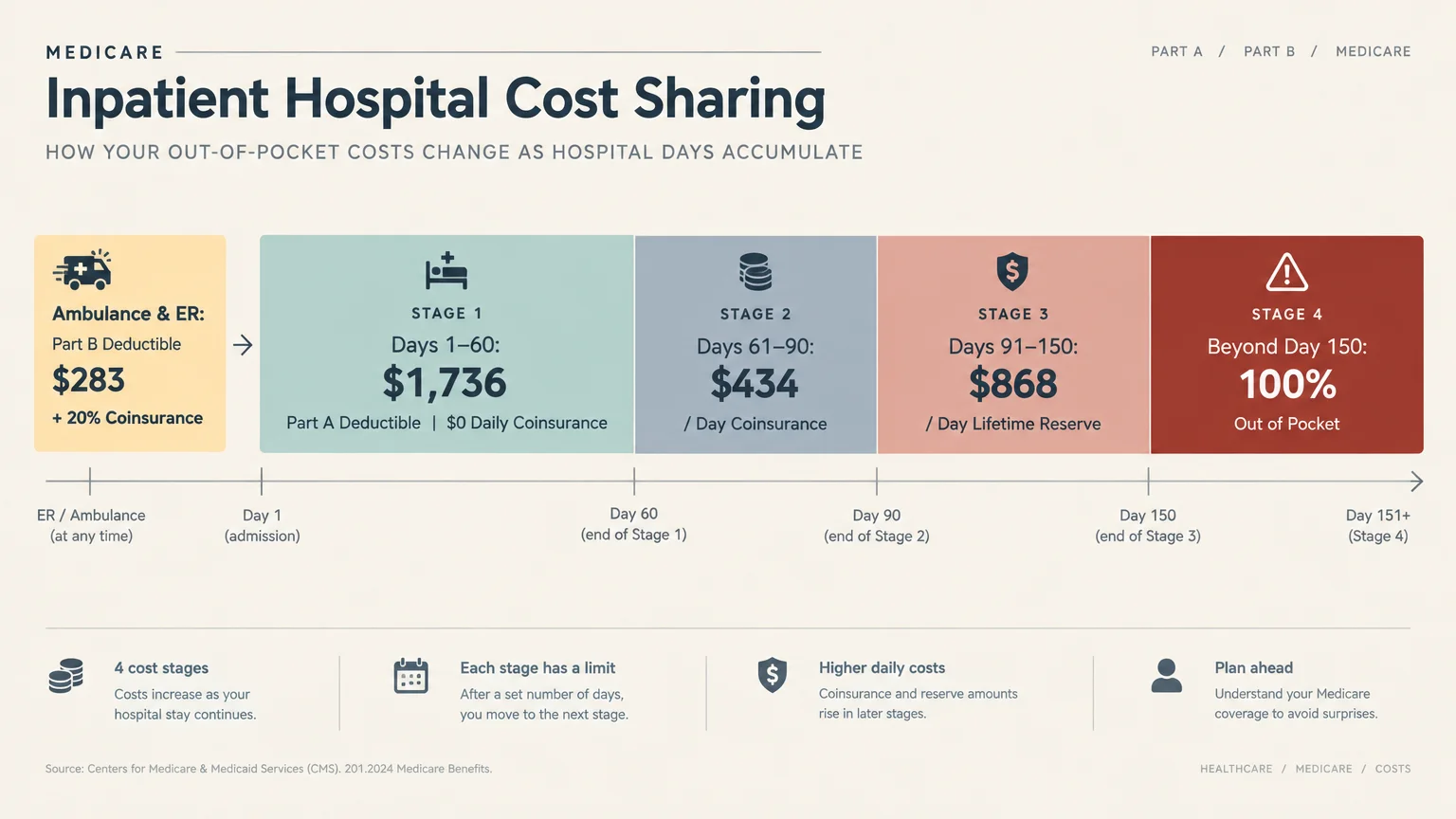
You pay 20% coinsurance for ambulance transport after meeting your annual Part B deductible. For 2026, the annual Part B deductible is $283, and the standard monthly Part B premium is $202.90.
Emergency Department Charges
Emergency room care falls under Medicare Part B as outpatient services. You owe 20% of the Medicare-approved amount for physician consultations, diagnostic scans, and stabilization after satisfying your $283 Part B deductible.
If physicians admit you as an inpatient, your billing changes immediately. Medicare Part A covers room, board, and nursing care expenses upon formal inpatient admission.
Inpatient Hospital Deductible and Coinsurance
Under Medicare Part A, you pay no daily copayment for initial inpatient hospital care. Instead, you pay an inpatient hospital deductible of $1,736 per benefit period.
This single deductible covers your first 60 days in an inpatient bed. Daily hospital coinsurance for days 1 through 60 is $0.
If complications require an extended hospital stay, out-of-pocket costs rise. For days 61 through 90, you pay $434 per day in coinsurance.
Beyond day 90, you use your 60 lifetime reserve days at $868 per day. Once you exhaust those lifetime reserve days, you pay 100% of hospital charges.
Worked Example: Eleanor’s Fall and Hospital Stay
Consider Eleanor, a 72-year-old on Original Medicare who slipped on icy steps and fractured her hip. An ambulance transported her to a hospital, where an orthopedic surgeon admitted her for surgery.
Eleanor spent five days recovering in an inpatient room before discharge. Because the hospital admitted her, she paid the $1,736 Part A deductible and $0 daily coinsurance for room and nursing care.
Her ambulance transport and surgeon fees fell under Part B. She paid 20% coinsurance for those services after meeting her $283 Part B annual deductible.