
Fifteen widely used Medicare Part D prescription drugs will get lower negotiated prices starting January 1, 2027. If you or someone you help takes medication for diabetes, asthma, cancer, or heart risk, your pharmacy bills could change.
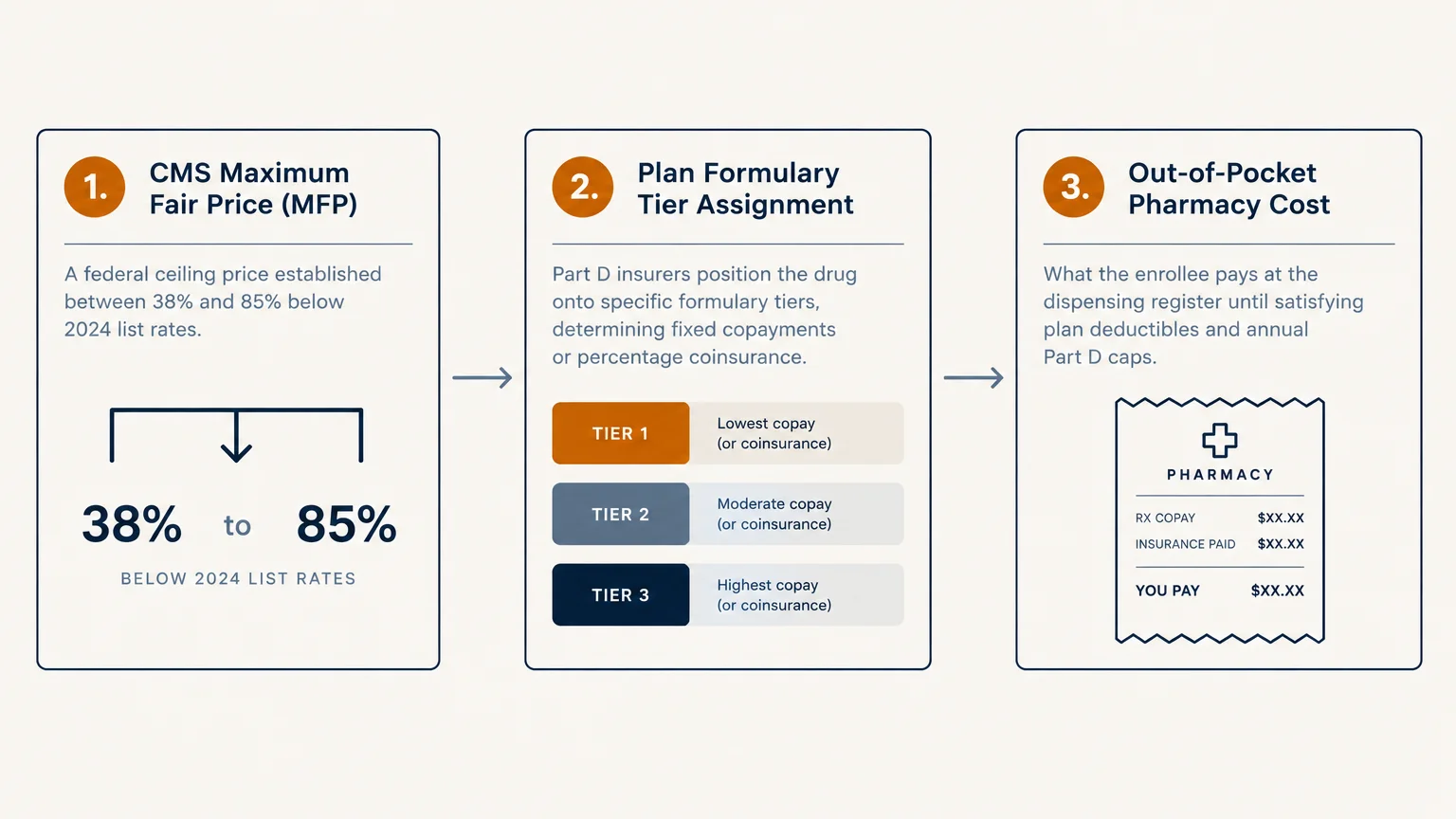
The Centers for Medicare & Medicaid Services (CMS) set these new maximum fair prices 38% to 85% below 2024 list prices for a 30-day equivalent supply.
Below, you can check all 15 medications, learn how your plan’s payment structure affects your real savings, and review key steps before Open Enrollment.
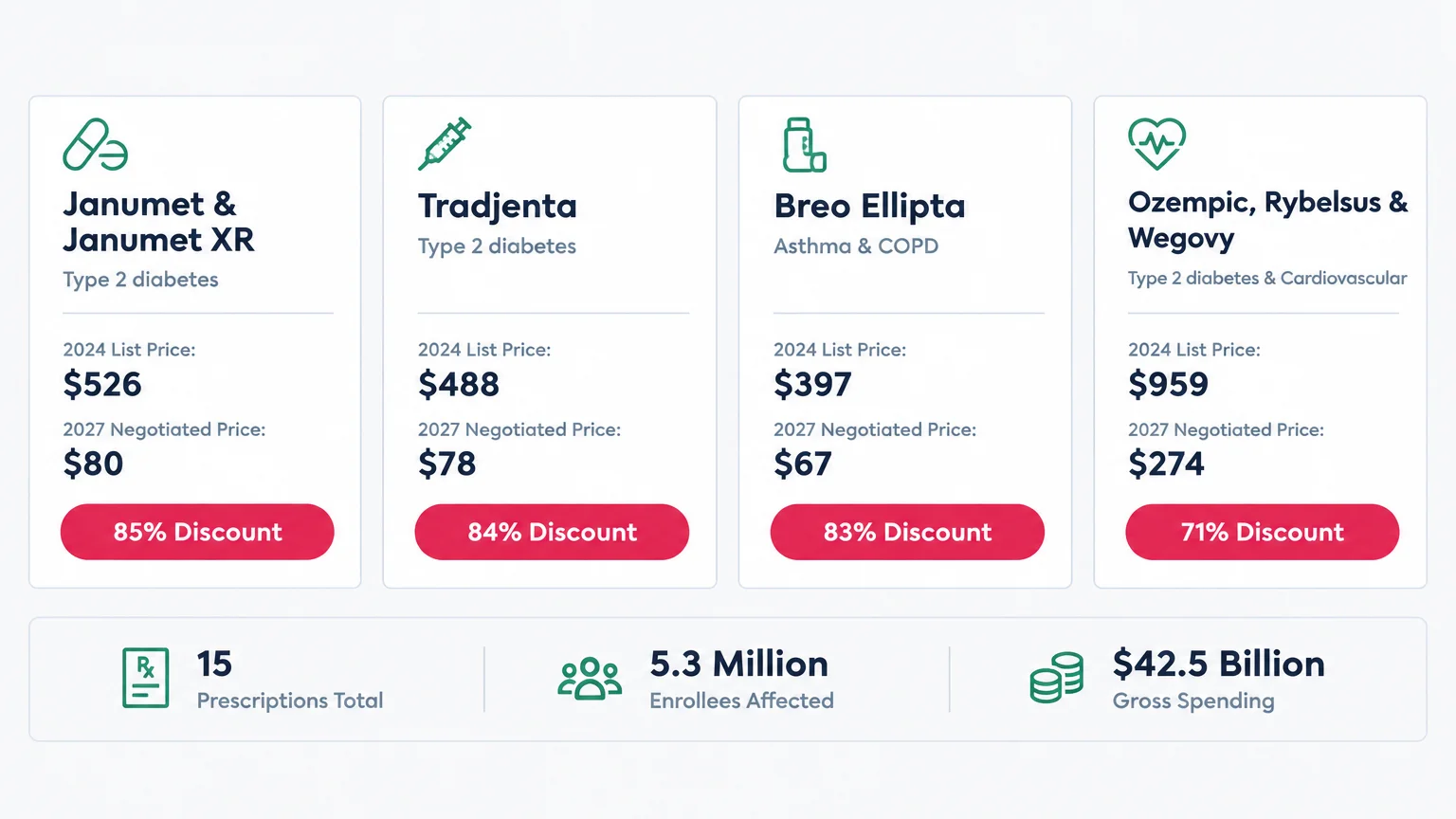
The 2027 Medicare Negotiated Drugs List at a Glance
On November 25, 2025, CMS announced the second round of negotiated prices under the Medicare Drug Price Negotiation Program. The Inflation Reduction Act of 2022 created this program, ending a ban that kept Medicare from negotiating drug prices since Part D began in 2006.
These new prices take effect on January 1, 2027, for eligible people enrolled in Medicare Part D. That includes both stand-alone Part D prescription plans and Medicare Advantage prescription drug (MA-PD) plans.
Under the law, drugmakers must honor each maximum fair price (MFP) for eligible Medicare enrollees and dispensing pharmacies. Every price below reflects a standardized 30-day equivalent supply, comparing 2024 Part D gross list prices to the 2027 negotiated prices set by CMS.
| Medication | Primary Conditions Treated | 2024 List Price (30-Day) | 2027 Negotiated Price (30-Day) | Discount |
|---|---|---|---|---|
| Janumet & Janumet XR | Type 2 diabetes | $526 | $80 | 85% |
| Tradjenta | Type 2 diabetes | $488 | $78 | 84% |
| Breo Ellipta | Asthma; chronic obstructive pulmonary disease (COPD) | $397 | $67 | 83% |
| Linzess | Chronic idiopathic constipation; irritable bowel syndrome with constipation | $539 | $136 | 75% |
| Trelegy Ellipta | Asthma; COPD | $654 | $175 | 73% |
| Ozempic, Rybelsus & Wegovy | Type 2 diabetes; cardiovascular disease; cardiovascular risk with obesity or overweight | $959 | $274 | 71% |
| Otezla & Otezla XR | Oral ulcers in Behcet’s disease; plaque psoriasis; psoriatic arthritis | $4,722 | $1,650 | 65% |
| Xifaxan | Hepatic encephalopathy; irritable bowel syndrome with diarrhea | $2,696 | $1,000 | 63% |
| Pomalyst | Kaposi sarcoma; multiple myeloma | $21,744 | $8,650 | 60% |
| Ibrance | Breast cancer | $15,741 | $7,871 | 50% |
| Ofev | Idiopathic pulmonary fibrosis | $12,622 | $6,350 | 50% |
| Xtandi | Prostate cancer | $13,480 | $7,004 | 48% |
| Vraylar | Bipolar I disorder; major depressive disorder; schizophrenia | $1,376 | $770 | 44% |
| Calquence | Chronic lymphocytic leukemia or small lymphocytic lymphoma; mantle cell lymphoma | $14,228 | $8,600 | 40% |
| Austedo & Austedo XR | Chorea in Huntington’s disease; tardive dyskinesia | $6,623 | $4,093 | 38% |
Why These 15 Medications Were Selected
Medicare chose high-spending brand-name drugs without generic or biosimilar competition that millions of older adults rely on. Roughly 5.3 million of the 53 million Part D enrollees in 2024 took at least one medication on this list.
Together, these 15 prescriptions accounted for $42.5 billion in gross Part D spending during calendar year 2024, according to CMS. Ozempic, Rybelsus, and Wegovy alone represented $15.16 billion in 2024 gross Part D spending across 2,282,000 users.
Trelegy Ellipta accounted for $5.30 billion across 1,269,000 Part D users in 2024, while Xtandi totaled $3.40 billion across 35,000 users. Otezla added another $1.05 billion in 2024 gross spending across 31,000 users.
CMS estimates that if these 2027 prices had applied in 2024, Medicare would have spent $12 billion less after rebates, a 44% reduction. Accounting for an older manufacturer discount program, CMS puts that net savings at $8.5 billion, or 36%.
For patients directly, CMS projects $685 million in lower out-of-pocket spending in 2027 under the standard Part D benefit design. You can review program details on the official CMS website.
Package Pricing Nuances for Ozempic, Rybelsus, and Wegovy
In the table above, Ozempic, Rybelsus, and Wegovy appear together at an average negotiated price of $274 per 30-day equivalent supply. That reflects a 71% drop from their $959 blended 2024 list price.
In practice, CMS sets package-specific prices across individual strengths and forms, so your exact pharmacy bill depends on your prescription. Here are three specific 2027 package prices listed by CMS:
- Ozempic: $276.78 for one 4 mg/3 mL pen.
- Rybelsus: $276.78 for 30 tablets of the 7 mg strength.
- Wegovy: $385.63 for a box of four 2.4 mg pens.
Keep in mind that these negotiated prices only apply when your Part D plan covers the medication for an approved Medicare use. Later in this guide, we explain how Medicare handles Wegovy coverage and weight-loss rules.
What Happened to the First Round of Negotiated Drugs?
The 2027 lineup builds on the first round of 10 Medicare Part D drugs whose negotiated prices started January 1, 2026. That first group included common blood thinners, diabetes pills, heart failure treatments, and autoimmune therapies.
Because lower-cost generic or biosimilar versions entered the market, CMS deselected four of those first-round drugs effective January 1, 2027. Those four deselected drugs are Stelara, Entresto, Xarelto, and NovoLog/Fiasp.
That leaves six first-round medications plus all 15 second-round medications—21 drugs in total—with active negotiated Medicare prices in 2027. If you take one of the four deselected drugs, ask your prescriber or pharmacist about generic or biosimilar alternatives for 2027.
Medicare’s negotiation work also continues into future years. On January 27, 2026, CMS selected 15 additional drugs for 2028, including physician-administered Part B drugs for the first time and a renegotiation of Tradjenta.
Those 2028 negotiated prices are due by November 30, 2026, and will take effect January 1, 2028. CMS also finalized rules on November 5, 2026, allowing up to 20 drugs to be selected per year starting with the 2029 cycle.
How Lower Negotiated Prices Change What You Pay at the Pharmacy
Seeing a 73% or 85% price drop on paper sounds straightforward, yet your counter receipt may tell a different story. The negotiated maximum fair price is what Medicare and Part D insurers pay for the drug, not automatically your personal copay.
How much you save at the pharmacy depends on your plan’s benefit phase and cost-sharing structure. Two neighbors taking the exact same medication from the same list can experience very different savings in 2027.
Coinsurance vs. Flat Copays: Why Your Experience May Differ
Part D plans generally charge either a flat dollar copay or a percentage coinsurance for covered prescriptions. Knowing which one your plan uses for your specific drug tier is the fastest way to spot real savings.
- If you pay coinsurance: You pay a percentage of the drug’s negotiated price, such as the standard 25% initial coverage coinsurance. When the underlying price falls sharply, your dollar share drops right away.
- If you are in your deductible stage: You pay the negotiated price until you meet your plan’s deductible. Lower negotiated prices reduce what you pay per fill during this phase, though it takes more fills to clear the deductible.
- If you pay a flat copay: You pay a fixed amount per fill, such as $47 per month. Your counter cost may not change in 2027 unless your plan moves the drug to a cheaper tier or lowers that tier’s copay.
Lower negotiated prices can also affect how quickly you reach Medicare’s annual out-of-pocket cap. Because each fill counts toward the cap at a lower price, patients with moderate drug costs may take longer to reach full catastrophic protection.
Meanwhile, people taking specialty cancer or neurological drugs on this list—such as Pomalyst, Ibrance, Ofev, Xtandi, Calquence, or Austedo—often still hit the annual cap. Even then, the lower negotiated prices help hold down overall Part D plan premiums and taxpayer costs.
Worked Example: Comparing Two Patients Taking Trelegy Ellipta
Suppose Arthur and Beatrice both manage COPD with Trelegy Ellipta and have already satisfied their plan deductibles for 2027. Under CMS pricing, Trelegy Ellipta’s 30-day list price drops from $654 in 2024 to a 2027 negotiated price of $175.
Arthur is enrolled in a Part D plan that charges a standard 25% coinsurance for Trelegy Ellipta. At the old $654 price, a 25% share worked out to roughly $163.50 per 30-day fill.
At the 2027 negotiated price of $175, Arthur’s 25% coinsurance drops to about $43.75 per fill. That saves Arthur nearly $120 every month during his initial coverage phase, or more than $1,400 over a full year if he stays in that phase.
Beatrice, on the other hand, belongs to a plan that charges a flat $47 monthly copay for her inhaler tier. Unless her insurer reduces that flat copay or shifts Trelegy Ellipta to a cheaper preferred tier, Beatrice still pays $47 per month in 2027.
For Beatrice, checking whether another plan in her area charges less—either through a lower flat copay or a lower premium—becomes her smartest move. You should check your exact plan tier rules before assuming your pharmacy bill will fall automatically.
Guaranteed Formulary Coverage vs. Plan Restrictions
Every stand-alone Part D plan and MA-PD plan must include all 15 negotiated drugs on its formulary starting January 1, 2027. Plans must keep each drug covered for as long as its negotiated maximum fair price remains active.
This rule protects you from having your medication dropped entirely from your plan’s drug list mid-cycle. However, mandatory formulary coverage does not guarantee hassle-free approval at the pharmacy counter.
Insurers can still place utilization management rules on these 15 drugs in 2027. Watch for three common restrictions when you review plan documents:
- Prior authorization: Your doctor must submit paperwork proving the medication is medically necessary for a covered condition before your plan pays.
- Step therapy: Your plan requires you to try a less expensive alternative first before approving the negotiated brand-name drug.
- Quantity limits: Your plan restricts how many pills, pens, or inhalers you can receive within a 30-day or 90-day period.
If your plan adds one of these rules for 2027, ask your doctor’s office early to submit any required documentation. Handling paperwork in December prevents frustrating delays at the pharmacy counter in January.
Key 2027 Medicare Part D Rules That Shape Your Drug Budget
Negotiated drug prices do not operate in a vacuum. Several broader Medicare Part D rule changes taking effect in 2027 will influence your total prescription spending alongside these 15 discounts.
Understanding the annual cap, maximum deductible, and premium shifts helps you see the whole financial picture. You should weigh all of these pieces together when comparing 2027 plans.
The Annual Out-of-Pocket Cap Rises to $2,400 in 2027
Medicare Part D caps how much you can spend out of pocket each year on covered prescription drugs. In 2027, that annual out-of-pocket limit rises 14.3% to $2,400, up from $2,100 in 2026 and $2,000 in 2025.
Once your qualifying out-of-pocket spending reaches $2,400 in 2027, you pay $0 for covered Part D prescriptions for the rest of the calendar year. Qualifying payments made on your behalf, such as assistance from Medicare’s Extra Help program, also count toward that $2,400 threshold.
Remember that only drugs covered by your Part D plan count toward the $2,400 cap. Non-covered medications, excluded weight-loss prescriptions, and cash purchases outside your plan do not move you closer to $0 fills.
Higher Deductibles, Base Premiums, and More Plan Volatility
The maximum allowable Part D deductible increases to $700 in 2027, up from $615 in 2026. Some Part D plans still charge a $0 deductible or waive the deductible for lower-tier generics and covered insulin products.
CMS also set the 2027 national base beneficiary premium at $41.33 per month, compared with $38.99 in 2026. While your actual plan premium varies by insurer and zip code, Medicare uses this national base figure to calculate late-enrollment penalties.
If you go 63 days or longer without creditable prescription drug coverage after first becoming eligible, Medicare adds a permanent penalty to your monthly Part D premium. That penalty equals 1% of the national base premium multiplied by the number of full uncovered months.
At the same time, CMS is ending its temporary Part D Premium Stabilization Demonstration after 2026. Because that federal cushion is expiring, individual stand-alone Part D premiums and drug tiers may shift more noticeably in 2027 than in recent years.
Official 2027 premiums, deductibles, and drug tiers for specific private plans are not reflected in national averages alone. Those plan-specific numbers appear in your fall plan notices and on the official Medicare.gov Plan Finder ahead of Open Enrollment.
Spreading Out High Upfront Costs With the Medicare Prescription Payment Plan
Even with a $2,400 annual cap and lower negotiated prices, paying hundreds or thousands of dollars in January can strain a fixed monthly budget. That challenge often hits people taking high-cost specialty drugs like Ibrance, Pomalyst, Ofev, Xtandi, Calquence, or Austedo.
To smooth out those spikes, you can opt into the Medicare Prescription Payment Plan (MPPP), which remains available in 2027. This optional program lets you spread your out-of-pocket Part D costs into capped monthly installments across the calendar year.
Under the MPPP, you pay $0 at the pharmacy counter for covered Part D prescriptions and receive a separate monthly bill from your Part D plan instead.
Per CMS, this program does not lower your total annual drug spending, but it prevents painful lump-sum bills early in the year.
Enrollment is voluntary, and you can sign up through your Part D or MA-PD plan before the year starts or anytime during 2027. Keep in mind that if you miss monthly payments, your plan can remove you from the payment program.
GLP-1 Weight-Loss Rules, Cash Discount Cards, and Common Traps
Because Ozempic, Rybelsus, and Wegovy appear on the 2027 negotiated list, many Medicare enrollees wonder whether weight-loss drugs are suddenly covered. The rules around glucagon-like peptide-1 (GLP-1) medications remain strict, and misunderstanding them can lead to surprise bills.
Cash discount websites present another common trap for people trying to save money on prescriptions. Knowing what counts toward your Medicare protections—and what does not—protects both your wallet and your annual cap progress.
Medicare Coverage Rules for Wegovy and the $50 Bridge Program
Federal law still bars standard Medicare Part D plans from covering medications prescribed solely for weight loss. However, Medicare Part D does cover specific GLP-1 medications when prescribed for other approved medical conditions.
- Ozempic and Rybelsus: Standard Part D plans cover these medications when prescribed to treat Type 2 diabetes.
- Wegovy: Standard Part D plans cover Wegovy when prescribed to reduce cardiovascular risk in adults with overweight or obesity who have established cardiovascular disease.
Separately, CMS launched a temporary Medicare GLP-1 Bridge demonstration that runs from July 1, 2026, through December 31, 2027. Under this program, eligible Part D enrollees can obtain select weight-loss GLP-1 medications—including Wegovy and Zepbound—for a $50 monthly copay.
To qualify for the $50 Bridge copay, you must receive prior authorization, and your healthcare provider must certify that you participate in a diet-and-exercise lifestyle program. Ask your doctor and Part D plan whether you meet the eligibility rules for the Bridge demonstration.
Crucially, Bridge copays sit outside standard Part D cost-sharing protections. Those $50 monthly payments do not count toward your 2027 Part D deductible or your $2,400 out-of-pocket cap, and Extra Help subsidies cannot be applied to them.
Why Cash Discount Cards and Websites Bypass Your Medicare Protections
Sometimes a cash coupon or online discount website—including TrumpRx.gov—advertises a lower price than your Part D plan’s copay. Paying cash occasionally feels tempting, especially while working through a high deductible.
Before pulling out a credit card outside your insurance, check the warning in the official Medicare & You 2027 handbook. Using cash discount cards or websites instead of your Medicare Part D coverage does not apply toward your deductible or your $2,400 out-of-pocket cap.
Relying solely on cash discount websites instead of enrolling in a Part D plan also fails to count as creditable prescription coverage. Going 63 or more days without creditable coverage can trigger permanent Medicare Part D late-enrollment penalties later.
If you already have Part D and want to compare a cash coupon against your insurance, run the math for the full year first. A lower one-time cash price could slow your progress toward the $2,400 cap and cost you more overall.

Steps to Check Your Prescriptions and Plan Options for 2027
You do not need to wait until January 2027 to find out how these negotiated prices affect your household. Taking a few organized steps during fall 2026 puts you in full control before any new plan rules lock in.
Adult children helping parents manage Medicare can follow this exact checklist alongside them. Having an updated medication list ready makes every comparison faster and more accurate.
Mark Your Calendar for Open Enrollment and Read Your ANOC
Medicare Open Enrollment for 2027 coverage runs from October 15 through December 7, 2026. Any Part D or Medicare Advantage plan change you make during this window takes effect automatically on January 1, 2027.
Before Open Enrollment begins, watch your mailbox or inbox for your plan’s Annual Notice of Change (ANOC). Insurers send this document each fall to spell out next year’s premiums, deductibles, drug tiers, and coverage rules.
When reviewing your ANOC for 2027, check four specific items for every drug you take:
- Tier placement: Confirm whether your medication moved to a higher or lower cost-sharing tier for 2027.
- Copay vs. coinsurance: Check whether your plan charges a flat dollar amount or a percentage of the drug price.
- Coverage restrictions: Look for new prior authorization, step therapy, or quantity limit flags next to your prescriptions.
- Monthly premium and deductible: Note any jump in monthly premiums or deductibles, especially as the temporary Premium Stabilization Demonstration ends after 2026.
If you never open your ANOC, you could miss a costly tier change or pharmacy network shift. Taking 15 minutes to review those pages can prevent hundreds of dollars in unexpected bills next winter.
Compare Total 2027 Costs on Medicare’s Plan Finder
Once 2027 plan details go live in October 2026, enter your exact medications, dosages, and preferred pharmacies into the official Medicare.gov Plan Finder. Do not judge a plan by its monthly premium alone.
Instead, compare estimated total annual out-of-pocket costs, which combine premiums, deductibles, and pharmacy copays across the whole year. Because negotiated prices lower costs on some tiers, a plan that looked expensive in 2026 might become your best value in 2027.
Also check whether switching between preferred in-network pharmacies lowers your share even further. Mail-order 90-day fills can sometimes save extra money on maintenance drugs like Janumet, Tradjenta, Breo Ellipta, or Trelegy Ellipta.
Be cautious about enrolling based solely on television ads or unsolicited phone calls. Always verify every drug, pharmacy, and restriction directly on Medicare’s official comparison tool before switching plans.
Where to Get Free, Unbiased Help With Your 2027 Choices
You never have to untangle Medicare Part D rules, drug lists, or payment plans by yourself. Free, unbiased counselors can review your exact medication list with you and explain your local options without trying to sell you a policy.
- State Health Insurance Assistance Program (SHIP): Local trained counselors offer free one-on-one help comparing Part D and MA-PD plans; find your state office at shiphelp.org.
- Official Medicare helpline: Call 1-800-MEDICARE anytime, 24 hours a day, 7 days a week, for plan comparisons and coverage questions.
- Extra Help with drug costs: If you have limited income and resources, check eligibility for Medicare’s Extra Help program through the Social Security Administration (SSA) at ssa.gov or by calling 1-800-772-1213.
If you qualify for Extra Help, your Part D deductible, copays, and premiums drop sharply, and Extra Help payments count toward the $2,400 cap. Checking eligibility takes only a few minutes and can transform an unaffordable drug budget.
Frequently Asked Questions About 2027 Medicare Drug Prices
Do I need to sign up for the 2027 negotiated prices?
No separate enrollment or discount card is required to get the 2027 negotiated prices. As long as you are enrolled in a Medicare Part D or MA-PD plan and your prescription meets plan coverage rules, the negotiated price applies automatically starting January 1, 2027.
Remember that the Medicare Prescription Payment Plan is separate and optional. You do need to opt in through your plan if you want to spread your 2027 out-of-pocket costs into monthly installments.
Can my Part D plan drop one of these 15 drugs in 2027?
No, every stand-alone Part D plan and MA-PD plan must keep all 15 negotiated drugs on its formulary while a negotiated maximum fair price is active. However, plans can still apply prior authorization, step therapy, or quantity limits.
Plans can also adjust which cost-sharing tier holds the drug from year to year. Always check your fall ANOC to confirm how your plan covers your medication for 2027.
Will my pharmacy automatically charge me less at the counter?
Not necessarily, because your counter cost depends on whether you pay a percentage coinsurance or a flat dollar copay. People paying coinsurance or working through a deductible typically see immediate counter savings when a drug’s negotiated price falls.
People whose plans charge a flat monthly copay may see no counter change unless the plan moves the drug to a cheaper tier. Checking your 2027 plan’s tier structure during Open Enrollment tells you what to expect.
What if my prescription is not on the 2027 negotiated list?
You still benefit from the broader 2027 Part D protections even if none of your prescriptions appear on this list. Your annual out-of-pocket spending on covered Part D medications is still capped at $2,400 in 2027.
Your drug may also be among the six remaining first-round negotiated drugs active in 2027, or selected for the 2028 cycle. Asking your doctor about covered generics, biosimilars, or therapeutic alternatives can also uncover immediate savings today.