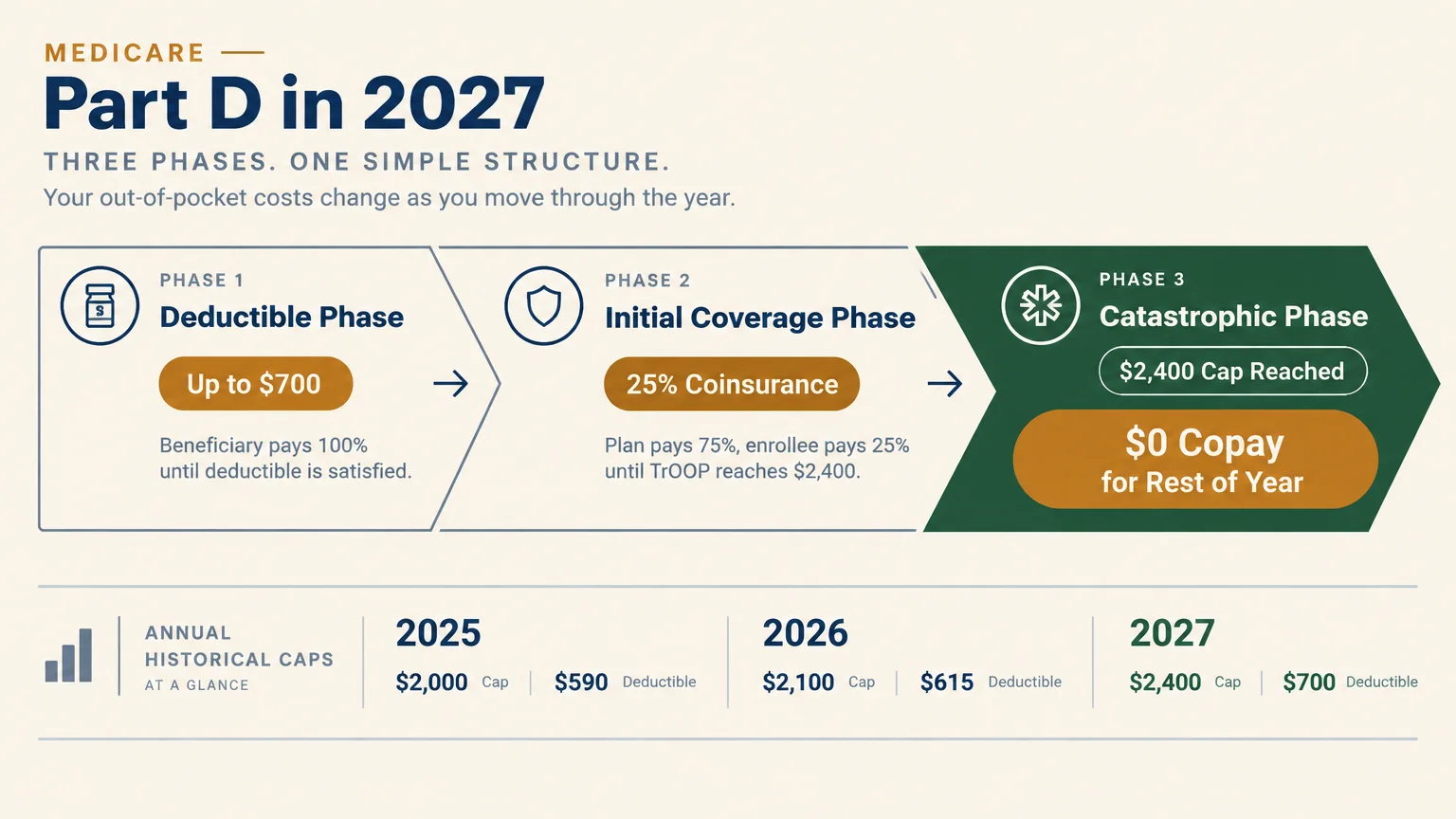
Starting January 1, 2027, Medicare Part D caps your annual out-of-pocket prescription drug costs at $2,400. Once you hit that spending ceiling, you pay $0 for your covered medications for the rest of the year.
This federal limit protects you from catastrophic drug costs, but related program rules are also changing. The maximum plan deductible rises to $700, and stand-alone plan premiums may climb sharply.
Reviewing your coverage during Medicare Open Enrollment ensures you maximize your savings. Knowing how the cap functions allows you to budget your pharmacy expenses with complete confidence.
Understanding the 2027 Part D Out-of-Pocket Cap and Deductible
The $2,400 out-of-pocket cap protects Medicare beneficiaries who take expensive prescription drugs. It builds upon previous caps of $2,000 in 2025 and $2,100 in 2026.
This spending ceiling applies strictly to True Out-of-Pocket (TrOOP) costs. TrOOP includes your deductible, copayments, and coinsurance for formulary-covered medications.
Deductibles and the Initial Coverage Phase
Before your plan pays for non-generic drugs, you may need to satisfy a deductible. The maximum Part D deductible for 2027 is $700.
Plans can charge a lower deductible or offer a $0 deductible on low-tier generics. Always review your plan details to see how your deductible applies.
After meeting your deductible, you enter the initial coverage phase. Standard Part D plans require 25% coinsurance for generic and brand-name drugs during this stage.
The coverage gap known as the donut hole remains permanently eliminated. You pay your standard coinsurance until your out-of-pocket spending reaches $2,400.
Reaching the Catastrophic Phase
Once your qualifying spending hits $2,400, you enter the catastrophic coverage phase. You pay $0 for all covered Part D medications for the remainder of the calendar year.
Your spending counter resets annually on January 1. You will start a new deductible and work toward the cap again each calendar year.
| Benefit Year | Out-of-Pocket Cap | Maximum Deductible | Catastrophic Cost-Sharing |
|---|---|---|---|
| 2025 | $2,000 | $590 | $0 |
| 2026 | $2,100 | $615 | $0 |
| 2027 | $2,400 | $700 | $0 |
This comparison highlights the annual adjustments to Medicare Part D cost-sharing limits. Even with a higher cap in 2027, catastrophic protection provides significant financial relief.