Medicare paperwork often reads like a foreign language designed to confuse you. Understanding a few foundational terms will immediately save you money and protect your healthcare choices.
Many beneficiaries accidentally overpay for medical treatments simply because they mistake coinsurance for a flat copay. Misjudging enrollment deadlines or annual resets can trigger lifetime financial penalties.
This guide translates complex Medicare vocabulary into plain English using official 2026 rates and confirmed 2027 figures. You will discover exactly what your plan covers and how your bills are calculated.
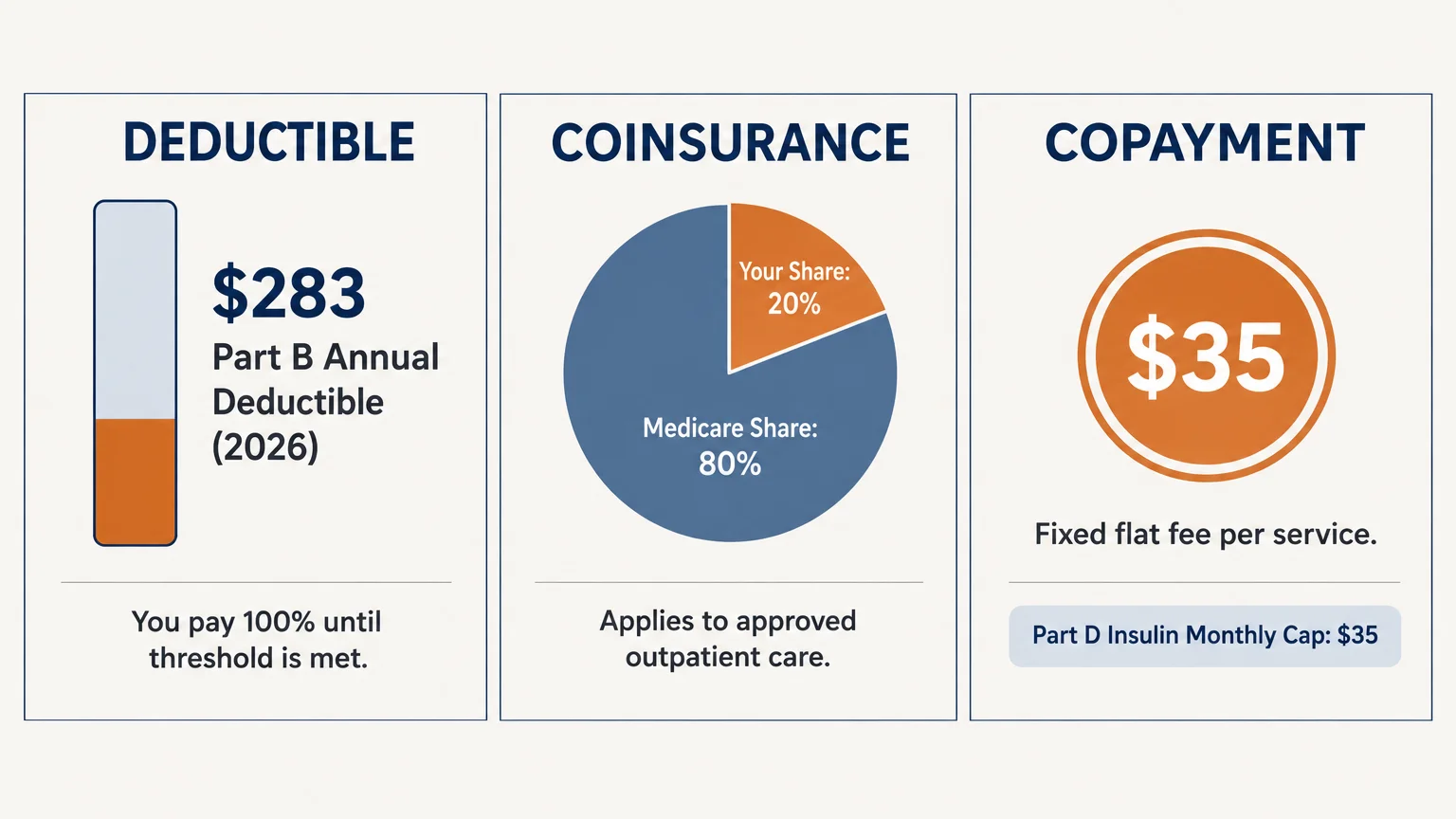
Deductible, Coinsurance, and Copayment: What You Pay
Deductible: Your Out-of-Pocket Starting Line
A deductible is the dollar amount you must pay out of pocket before your Medicare plan begins covering services.
Meeting your deductible resets your financial responsibility for the remainder of that coverage period.
For Medicare Part B, the annual outpatient deductible is $283 in 2026. The Centers for Medicare & Medicaid Services (CMS) announces official 2027 figures in late November.
Medicare Part D drug plans also feature an annual deductible cap. No plan may charge a deductible higher than $615 in 2026 or $700 in 2027.
However, many Part D insurance plans waive this deductible entirely or charge a lower amount for generic medications.
Coinsurance: Splitting the Bill by Percentage
Coinsurance is your share of medical costs calculated as a specific percentage. You pay coinsurance only after satisfying your deductible.
Under Part B, you typically pay 20% of the Medicare-approved amount for doctor visits and outpatient therapies. Medicare pays the remaining 80%.
Doctors who accept Medicare assignment agree to charge only the Medicare-approved amount, protecting you from extra balance billing.
Part A uses daily coinsurance fees for hospital stays over 60 days. In 2026, days 61 through 90 cost $434 daily, while lifetime reserve days cost $868 per day.
Copayment: A Fixed Dollar Charge
A copayment is a flat dollar fee you pay at the time of service. Unlike coinsurance, a copay does not change based on the total bill.
For example, federal law caps your copayment for covered Part D insulin products at $35 per month in both 2026 and 2027.
Check your plan formulary every year to see which drug tier your prescriptions occupy, as each tier carries a different copay.
Medicare Advantage plans frequently rely on copayments rather than percentages for primary care visits, specialist appointments, and routine laboratory tests.
Comparing Deductibles, Coinsurance, and Copayments
The table below summarizes how these three cost-sharing terms function across standard Medicare coverage.
| Cost-Sharing Term | How You Pay | Standard Medicare Example |
|---|---|---|
| Deductible | Fixed dollar amount before plan pays | $283 Part B annual deductible (2026) |
| Coinsurance | Percentage share of total service cost | 20% of outpatient doctor bills under Part B |
| Copayment | Flat dollar fee paid at the appointment | $35 monthly copay cap on covered Part D insulin |