Missing an initial Medicare sign-up deadline can trigger permanent monthly surcharges that drain your retirement budget. Fortunately, you can easily avoid these extra costs once you understand the federal enrollment rules.
The federal government charges separate late fees for hospital care, outpatient medical services, and prescription drug coverage. Each penalty uses different mathematical formulas, grace periods, and eligibility criteria.
This comprehensive guide breaks down current penalty costs, reveals dangerous coverage traps, and provides actionable steps to keep your healthcare premiums low.
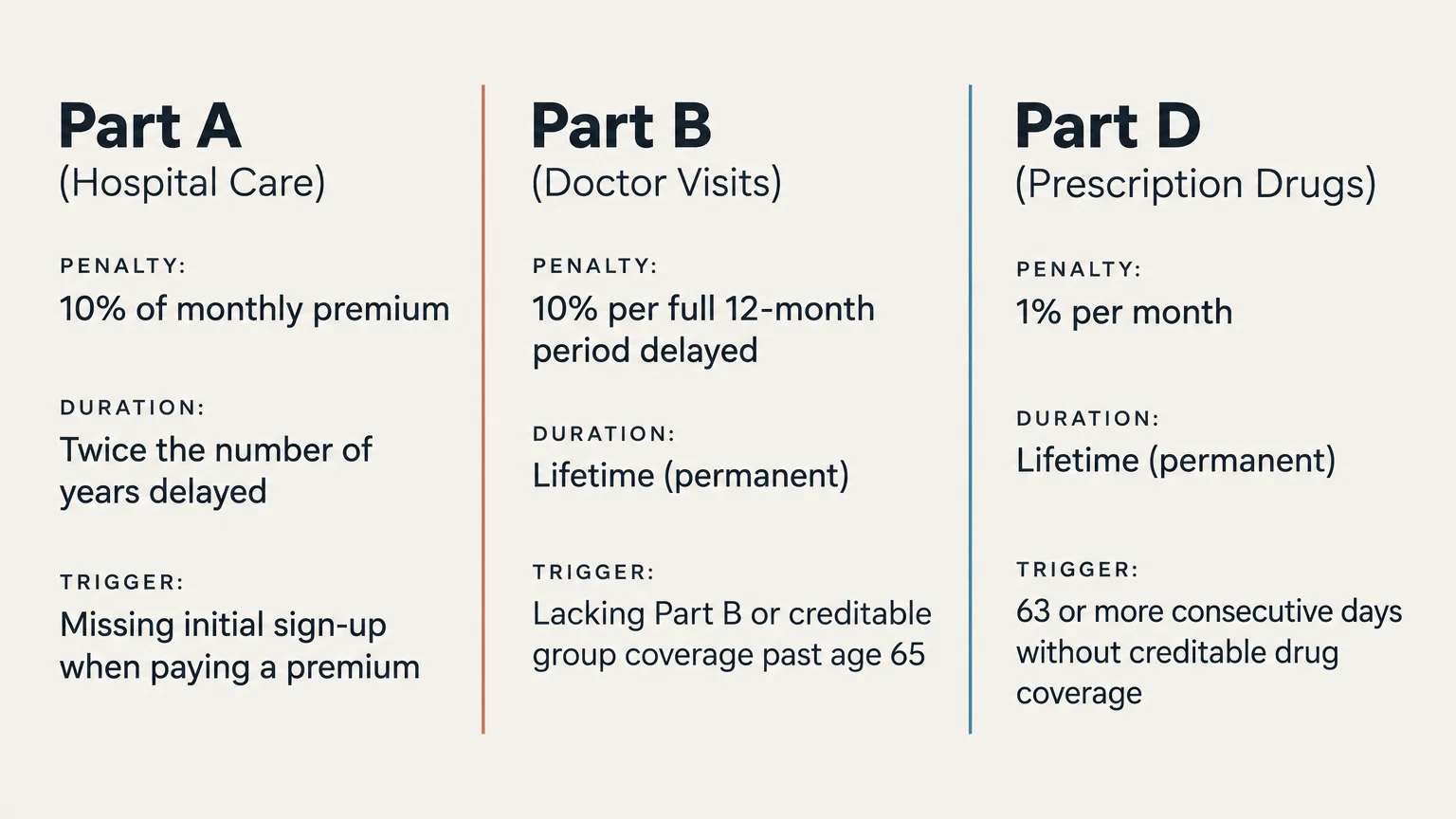
Understanding the Three Medicare Late Enrollment Penalties
Medicare consists of several distinct parts, each covering specific healthcare services. Because each part operates under different federal statutes, each maintains its own late enrollment rules.
Late enrollment penalties are not one-time fines. Instead, the government adds these surcharges directly to your monthly premiums—often for the rest of your life.
Medicare Part A covers inpatient hospital care, while Medicare Part B covers outpatient doctor visits. Meanwhile, Medicare Part D handles outpatient prescription medications.
Most Americans qualify for premium-free Part A and face no penalty risk for hospital insurance. However, delayed enrollment in Part B or Part D routinely catches retirees off guard.
Understanding the differences among these three penalties will help you protect your retirement savings. The comparison table below summarizes how each surcharge functions.
| Medicare Part | Penalty Rate | Penalty Duration | Trigger Condition |
|---|---|---|---|
| Part A | 10% of monthly premium | Twice the number of years delayed | Missing initial sign-up when paying a premium |
| Part B | 10% per full 12-month period delayed | Lifetime (permanent) | Lacking Part B or creditable group coverage past age 65 |
| Part D | 1% per month multiplied by base premium | Lifetime (permanent) | 63 or more consecutive days without creditable drug coverage |
As shown in the table, the financial consequences of missing deadlines vary across programs. Examining Part B reveals why timing matters so significantly.