How to Avoid Penalties: Timelines, Work Coverage, and Traps
Avoiding Medicare penalties requires tracking federal enrollment windows and knowing how your existing health insurance coordinates with Medicare.
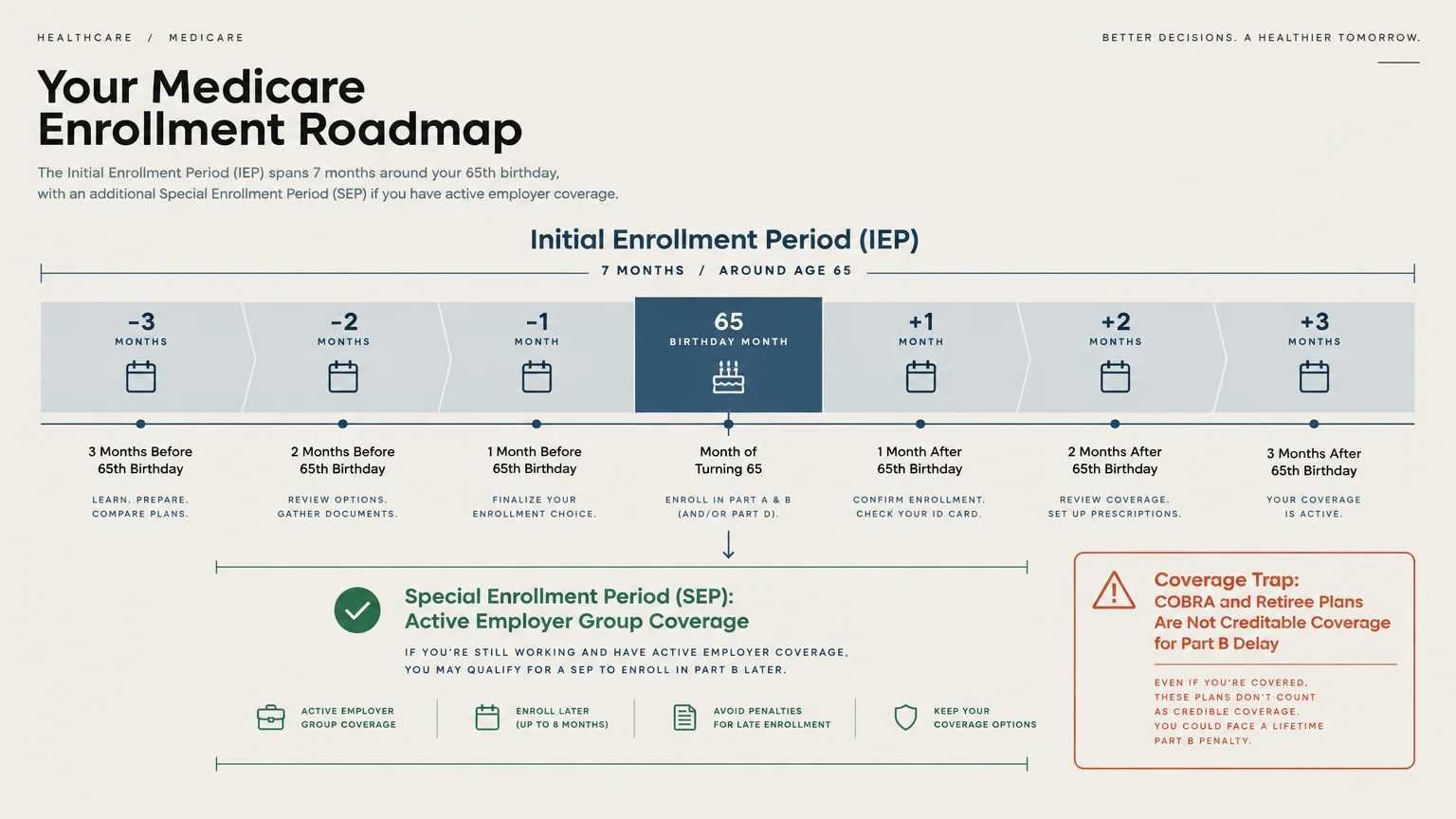
Your initial opportunity to sign up is your Initial Enrollment Period (IEP). This seven-month window begins three months before your 65th birthday month, includes your birthday month, and ends three months later.
The Working Past 65 Exception
If you or your spouse actively work past 65, you can delay Medicare without penalty under specific conditions. Your employer must employ 20 or more workers, and you must have active group health coverage.
When that active employment or group coverage ends, you qualify for an eight-month Special Enrollment Period (SEP) to enroll in Part A and Part B.
Prescription drug coverage, however, operates under a much stricter deadline. You have only two months (up to 63 days) after losing employer coverage to join a Part D plan without penalty.
The Dangerous COBRA and Retiree Coverage Trap
Many seniors fall into a costly trap involving the Consolidated Omnibus Budget Reconciliation Act (COBRA) or retiree health plans. Neither option counts as active employment coverage for Medicare Part B.
If you rely on COBRA after leaving your job at 65, your eight-month SEP clock starts running immediately upon retirement. Once those eight months expire, you lose your SEP entirely.
When you finally sign up, Medicare will assess the full Part B late enrollment penalty for your uncovered period. Never use COBRA as an excuse to postpone Part B enrollment.
COBRA and retiree coverage can sometimes count as creditable coverage for Part D. Check your plan’s written creditable coverage notice each year to confirm that your prescription coverage qualifies.
The General Enrollment Period and the BENES Act
If you miss your IEP and lack an SEP, you must enroll during the General Enrollment Period (GEP). The GEP runs annually from January 1 through March 31.
Previously, beneficiaries had to wait until July for GEP coverage to begin. Under the Beneficiary Enrollment Notification and Eligibility Simplification (BENES) Act, coverage now begins the first day of the month after you enroll.
To adjust or add Part D drug coverage, use the Annual Open Enrollment Period. This window runs from October 15 through December 7 each year, with new coverage taking effect January 1.
For free, personalized assistance, contact your local State Health Insurance Assistance Program (SHIP). You can also research plan options on Medicare.gov or call 1-800-MEDICARE.