The WISeR Model: New Approval Rules for Original Medicare
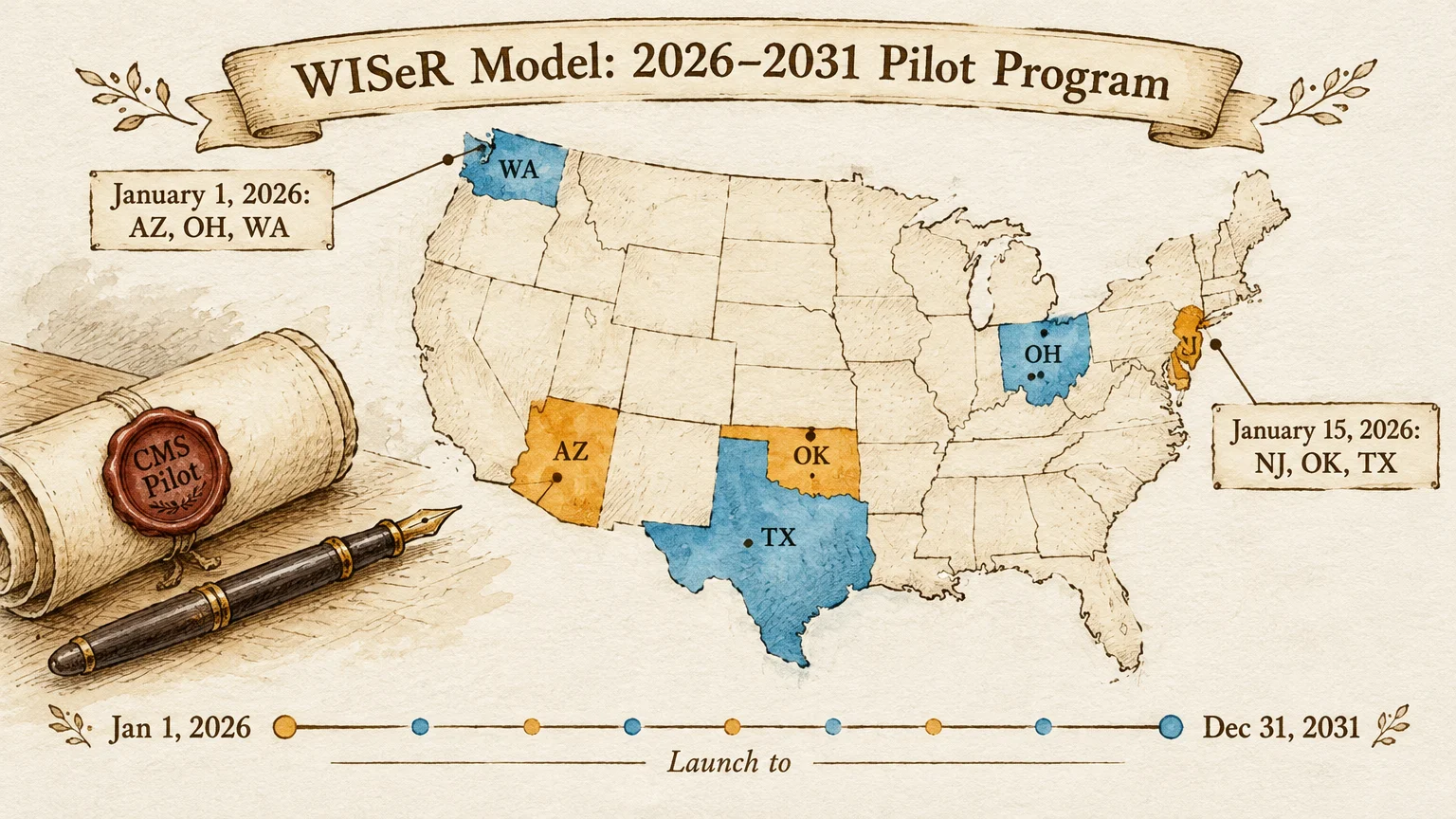
The Wasteful and Inappropriate Service Reduction (WISeR) Model represents an unprecedented experimental shift in traditional Medicare operations. This six-year pilot program from CMS officially launched on January 1, 2026, and runs through December 31, 2031.
The model applies strictly to Original Medicare Part A and Part B beneficiaries living in six designated states. Those states are Arizona, New Jersey, Ohio, Oklahoma, Texas, and Washington.
While the program began on New Year’s Day, enforcement in New Jersey, Oklahoma, and Texas was phased in starting January 15, 2026. If you have Original Medicare in any other state, WISeR does not apply to you.
Under the WISeR model, CMS contracted with six private technology companies, including Innovaccer, Humata Health, and Genzeon. These vendors deploy artificial intelligence (AI) and machine learning tools to evaluate incoming approval requests.
While human clinicians must review any prospective denials, automated algorithms handle the initial screening of your medical records.
CMS officially describes prior authorization under WISeR as voluntary for medical providers. However, this administrative label is deceptive.
If your physician chooses not to submit an authorization request before performing an eligible service, the claim is automatically suspended. Medicare then subjects the claim to mandatory pre-payment medical review before releasing payment.
Pre-payment reviews create substantial administrative friction for clinics and can delay billing resolution for months. Because of this financial risk, most doctors in the six pilot states treat the WISeR process as mandatory.
The model applies to care performed in hospital outpatient departments (HOPDs), ambulatory surgical centers (ASCs), physician offices, and the home. Emergency department care is strictly excluded from these requirements.
Early implementation has faced significant operational challenges. In late 2026, documents obtained through a Freedom of Information Act (FOIA) lawsuit by the Electronic Frontier Foundation (EFF) uncovered severe administrative bottlenecks.
These records revealed unready software portals and substantial delays, including one prior authorization request submitted to vendor Genzeon that languished unanswered for 83 days.
These severe backlogs mean you and your physician must plan ahead before scheduling non-emergency outpatient procedures in WISeR states.