Medicare Supplement Plan G vs. Plan N: Detailed Comparison
Key Differences in Copayments and Excess Charges
Plan G and Plan N have become the most popular choices for individuals newly eligible for Medicare. Both plans provide reliable coverage for major medical expenses, but they handle smaller bills differently.
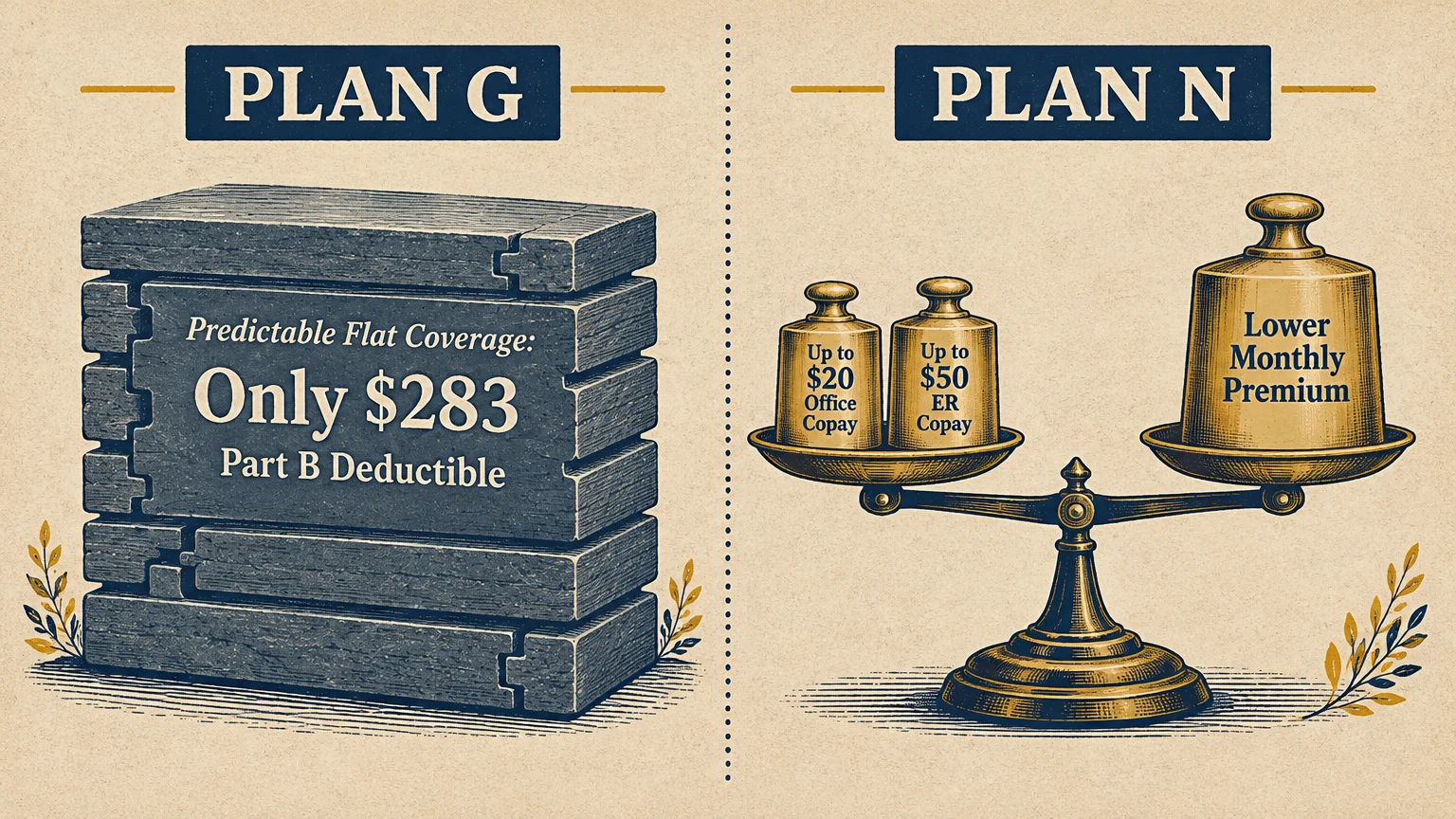
Neither plan covers the annual Part B deductible of $283 in 2026. Once you satisfy that deductible, Plan G pays 100 percent of your remaining Medicare-approved outpatient costs.
With Plan G, you owe $0 in copayments when visiting doctor offices, clinics, or specialist practices.
Plan N reduces your monthly premium by requiring modest copayments. You pay up to $20 for certain doctor office visits and up to $50 for emergency room (ER) visits that do not result in inpatient admission.
Plan G also covers Part B excess charges, while Plan N does not. Doctors who do not accept Medicare assignment can legally bill you up to 15 percent above the Medicare-approved charge.
Because many states ban excess charges and most physicians accept Medicare assignment, excess charges occur infrequently. You can consult educational resources at Medicare Interactive to check billing rules in your state.
Worked Example: Choosing Between Plan G and Plan N
Consider Evelyn, who turns 65 in 2026 and enjoys good health. She visits her primary care doctor twice a year and sees a cardiologist once annually.
A private carrier quotes Evelyn $165 per month for Plan G and $125 per month for Plan N. Choosing Plan N saves her $40 per month, totaling $480 in premium savings annually.
Evelyn pays her $283 Part B deductible under either policy. With Plan N, her three specialist and wellness appointments trigger three $20 copayments, totaling $60 for the year.
Subtracting her $60 in office copayments from her $480 premium savings leaves Evelyn with $420 in net annual savings. Because her doctors accept Medicare assignment, Plan N delivers lower total costs for her routine healthcare needs.