Original Medicare leaves noticeable financial gaps, including deductibles, daily hospital copayments, and a standard 20 percent outpatient coinsurance. Medicare Supplement Insurance, commonly known as Medigap, shields you from these unpredictable out-of-pocket medical bills.
Private insurance companies sell ten standardized lettered Medigap policies in most states. Each lettered plan provides the exact same core benefits regardless of which company manages your policy.
This side-by-side comparison outlines what each Medigap plan covers, highlights key differences between top options, and explains enrollment rules so you can protect your healthcare budget.
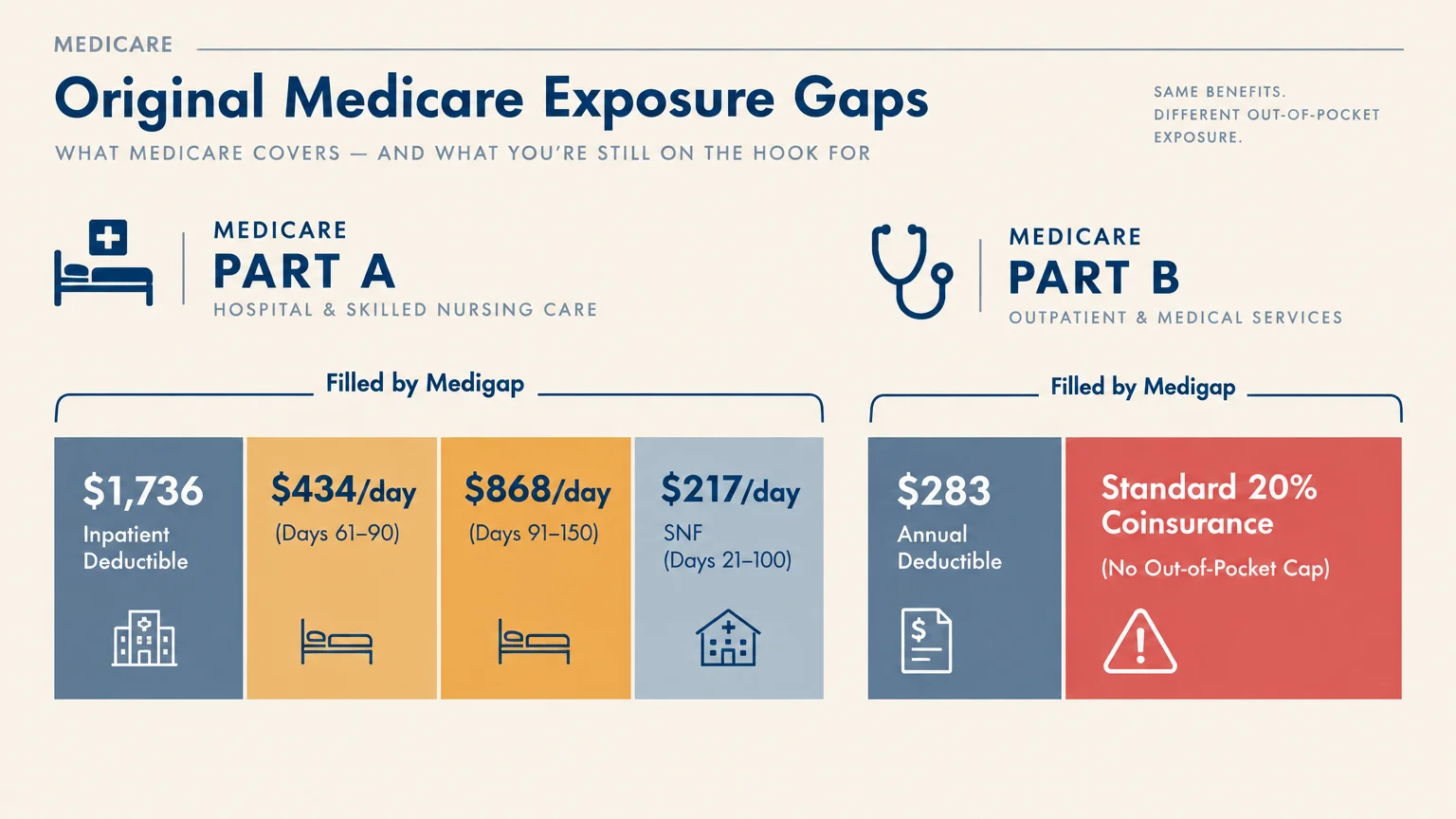
How Standardized Medigap Plans Fill Medicare Coverage Gaps
Understanding Out-of-Pocket Costs in Original Medicare
Original Medicare consists of Part A hospital insurance and Part B medical insurance. While this program pays for many essential services, it never covers 100 percent of your healthcare costs.
For inpatient hospital stays, Medicare Part A requires a $1,736 deductible per benefit period in 2026. Projections from Medicare trustees indicate this deductible will rise to $1,788 in 2027.
If your hospital stay lasts past 60 days, you pay daily coinsurance fees. You owe $434 per day for days 61 through 90 in 2026, projected to reach $447 in 2027.
For days 91 through 150, you use lifetime reserve days and pay $868 per day in 2026. Trustees project this cost will climb to $894 per day in 2027.
Skilled nursing facility (SNF) care also requires coinsurance after day 20. You pay $217 per day for days 21 through 100 in 2026, projected to reach $223.50 in 2027.
Medicare Part B covers outpatient visits, laboratory work, and preventive care. You must satisfy an annual Part B deductible of $283 in 2026, projected to rise to $292 in 2027.
After meeting that deductible, you generally pay a 20 percent coinsurance on all doctor visits, diagnostic tests, and therapies. Medicare Part B includes no annual out-of-pocket maximum, meaning severe medical events can create massive medical bills.
Federal Standardization Across States
Federal law standardizes Medigap plans into ten lettered options: A, B, C, D, F, G, K, L, M, and N. Insurers across 47 states and Washington, D.C., must follow these strict benefit categories.
Because benefits are standardized, a Plan G from one insurer provides the exact same medical coverage as a Plan G from another. Only monthly premiums and customer service differ between companies.
Three states—Massachusetts, Minnesota, and Wisconsin—operate under distinct state waiver rules. If you live in one of these three waiver states, your state government organizes Medigap policies using alternative state-specific coverage structures.
To verify which standardized options operate in your county, visit Medicare.gov to review local plan availability.