Comparing the Three Key Programs: QMB, SLMB, and QI
Three primary programs help Medicare beneficiaries eliminate their Part B monthly premium. Each option features distinct financial limits and specific benefit tiers.
Qualified Medicare Beneficiary (QMB)
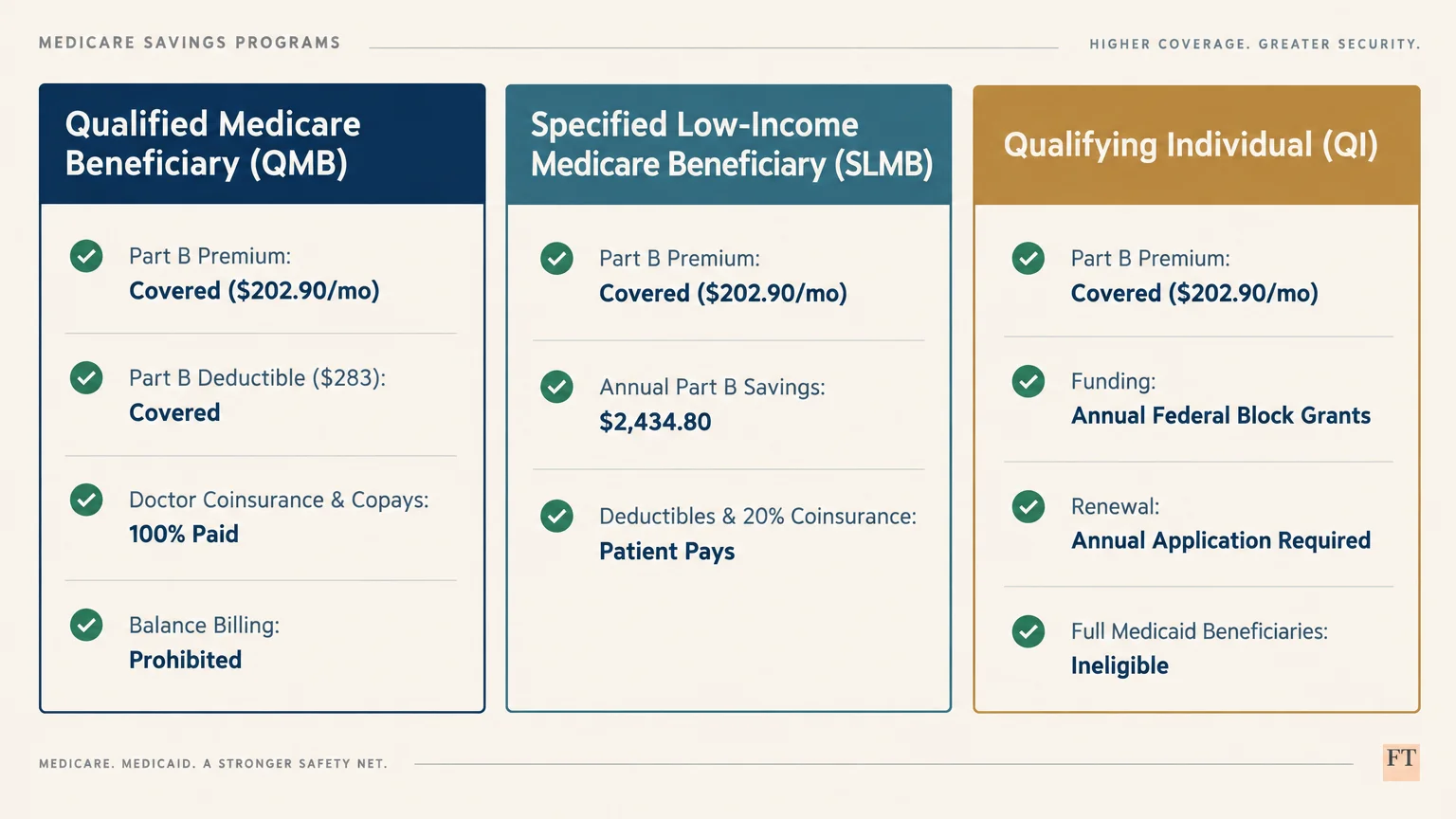
The Qualified Medicare Beneficiary (QMB) program offers the highest level of financial protection among all savings tiers. It covers both Part A and Part B premiums.
QMB also pays all Medicare deductibles, coinsurance, and copayments for covered services. This means you owe nothing for approved doctor visits or hospital stays.
Federal law strictly prohibits medical providers from balance billing any patient enrolled in QMB. Even if Medicare pays less than the billed charge, doctors cannot demand payment from you.
Specified Low-Income Medicare Beneficiary (SLMB)
The Specified Low-Income Medicare Beneficiary (SLMB) program serves individuals with slightly higher incomes than the QMB threshold. It provides meaningful cost relief without full Medicaid enrollment.
SLMB pays your entire monthly Part B premium, saving you $2,434.80 across 2026. This benefit directly prevents premium deductions from your monthly Social Security benefit.
However, SLMB does not cover Medicare deductibles or standard 20 percent outpatient coinsurance charges. You remain responsible for those medical expenses unless you hold additional coverage.
Qualifying Individual (QI)
The Qualifying Individual (QI) program provides the highest income ceiling among Part B assistance programs. Like SLMB, QI covers your full monthly Part B premium.
Unlike other tiers, QI operates through annual federal block grants awarded on a first-come, first-served basis. Once a state exhausts its yearly grant allocation, it closes enrollment.
You must submit a renewal application every calendar year to keep your QI benefits active. Additionally, individuals who already qualify for full Medicaid cannot enroll in QI.
Summary of Program Coverage and Limits
Reviewing the core differences between these three programs helps clarify which option aligns with your finances.
| Program Name | 2026 Monthly Income Limit | 2026 Resource Limit | Program Coverage |
|---|---|---|---|
| QMB | $1,350 individual / $1,824 couple | $9,950 individual / $14,910 couple | Part A and B premiums, deductibles, coinsurance, copayments |
| SLMB | $1,616 individual / $2,184 couple | $9,950 individual / $14,910 couple | Part B premium only ($202.90 per month in 2026) |
| QI | $1,816 individual / $2,455 couple | $9,950 individual / $14,910 couple | Part B premium only (annual reapplication required) |
Income limits shown reflect published federal thresholds for the 48 contiguous states and the District of Columbia.